
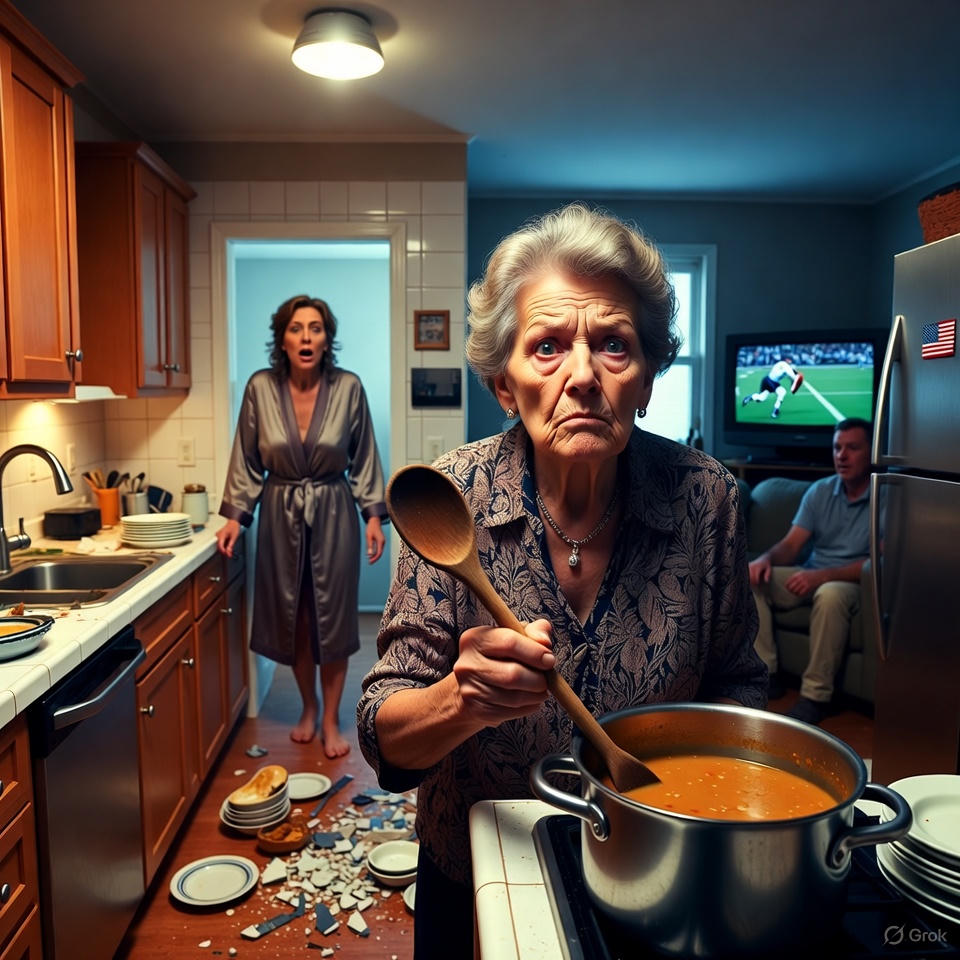
“I didn’t hear it, Mom. I didn’t. I didn’t know—”
Liar.
The word hung between us like poison.
“You were there. You heard everything, and you chose to do nothing.”
Dawn stepped between us, her face red with rage.
“I won’t tolerate this. I won’t live under the same roof as this ungrateful old woman who respects nothing. Robert, you have to choose. Either she leaves or I do.”
The silence that followed was worse than any scream.
I looked at my son, begging him with my eyes to choose me, to remember who raised him, who spent sleepless nights when he had a fever, who worked two jobs to pay for his college.
But Robert was looking at the floor, his hands in his pockets, defeated.
“I’m sorry, Mom,” he finally mumbled. “But I think… I think it’s better if you look for somewhere else. This isn’t working. You’re causing problems. You need… you need to leave.”
The world stopped. My heart stopped. Everything stopped.
“You’re kicking me out?” I asked, although I already knew the answer. “Your wife hits me and you kick me out.”
“It’s not like that, Mom. It’s just that Dawn and I need our space. You need your independence. It will be better for everyone.”
He spoke in rehearsed phrases, empty words that someone else had put in his mouth.
My son wasn’t there anymore. Only a stranger with his face remained.
“When?” I asked, feeling the tears start to burn behind my eyes.
“Tomorrow morning. I’ll call you a taxi. You can stay in a hotel while you find something permanent. I’ll… I’ll help you with some expenses.”
At first, he was dismissing me like an employee. He didn’t even have the courage to look me in the eye.
That night, I didn’t sleep. I sat on the edge of the bed, looking at Henry’s photographs, wondering what he would say if he could see me now.
I packed my things slowly, folding each item carefully, as if external order could contain the internal chaos.
At dawn, I heard the taxi horn. Robert was waiting for me at the door with two hundred dollars in his hand.
“For you to settle in,” he said, unable to meet my gaze.
I didn’t hug him. I didn’t say goodbye. I just took the money, grabbed my suitcases, and left that house without looking back.
The taxi driver asked me where I wanted to go.
I had no answer.
“To any cheap motel,” I finally told him.
He took me to a place on the outskirts of Los Angeles, one of those roadside motels with flickering neon signs and carpets that smelled of dampness. The room cost thirty dollars a night.
I did the math in my head. With two hundred dollars, I could survive for less than a week.
The motel room was small, with stained beige walls and a bed that creaked every time I moved. There was a window overlooking the parking lot where cars came and went at all hours of the night. The neon light of the sign flickered every few seconds, bathing everything in a sickly reddish glow.
I sat on that bed and, for the first time in months, cried without restraint. They weren’t silent tears. They were deep sobs that came from some dark place in my chest. Years of accumulated pain, swallowed humiliations, unspoken words.
I cried for Henry, who had left, leaving me alone in a world I no longer recognized. I cried for Robert, the child who once hugged me and called me his hero. I cried for myself, for the woman I had been and who now didn’t know who she was.
When the tears dried, only the emptiness remained.
I looked at myself in the bathroom mirror under the cruel fluorescent light. A seventy-one-year-old woman stared back at me. Deep wrinkles, swollen eyes, messy gray hair. There was a purple mark on my temple where the ladle had hit me.
I touched the wound gently and felt how the physical pain was almost a relief compared to the other pain, the one without a name.
The days began to blur. I stayed in the room all the time, watching television without really seeing it, eating the bare minimum. I only went out to buy something from the vending machine in the hallway—salty chips, instant coffee, granola bars.
Once, the machine swallowed my last two dollars without giving me anything in return. I stood there watching the money disappear and felt it was a perfect metaphor for my life.
I sent messages to Robert. At first, I tried to be dignified.
“Son, I need to talk to you.”
Nothing.
Then I tried to be more direct.
“Robert, I’m running out of money.”
Silence.
Finally, I stopped trying. The messages were marked as read, but there was never a response. It was like shouting into a bottomless pit.
A week later, the money ran out.
The motel receptionist, a man in his forties with a prominent belly and tired eyes, knocked on my door.
“Ma’am, I need you to pay or vacate the room.”
His voice wasn’t cruel, just professional, indifferent.
I explained my situation, begged for one more day, but he just shook his head.
“I’m sorry, ma’am. Those are the rules.”
I packed my suitcases again, four suitcases that now weighed like corpses. I dragged them through the parking lot under a scorching sun, not knowing where to go.
I walked for hours. My feet hurt. My hands had blisters from carrying so much weight. But I kept going because stopping meant accepting that I had nowhere to go.
I ended up in a park near downtown Los Angeles. There were metal benches under the trees, pigeons pecking at crumbs, children playing on the swings.
I sat on a secluded bench and watched life continue as if I didn’t exist.
A woman passed with her young daughter. The girl looked at me curiously, but her mother pulled her hand and quickened her pace as if poverty were contagious.
That was my first night sleeping on the street.
I didn’t really sleep. I stayed seated, clutching my purse, startled by every noise. There were other homeless people in the park, mostly men, who huddled under cardboard. One of them approached and offered me a piece of stale bread.
“Eat it, Grandma. You have to be careful out here.”
I took the bread with trembling hands and thanked him. He nodded and walked away, dragging a bag full of cans.
The days turned into a survival routine. I searched for food in the dumpsters behind restaurants. At first I was disgusted. I was ashamed. But hunger is stronger than pride.
I found day-old bread, bruised fruit, leftovers that people had left on their plates. I ate hidden in alleys where no one could see me.
There was a church a few blocks away that served soup on Tuesdays and Thursdays. I lined up with dozens of other people, all with broken stories written on their faces. A young volunteer served me the bowl with a compassionate smile that made me feel even smaller.

Yo Make również polubił
Domowy chleb: przepis na miękki chleb z chrupiącą skórką
5 ostrzegawczych znaków, że Twoja trzustka ma problemy
Moja babcia pokazała mi sztuczkę, dzięki której mogę bez wysiłku wyczyścić wannę w zaledwie dwie minuty. Oto jak.
Przystawki: Chrupiące trójkąty z ciasta filo i ricottą