
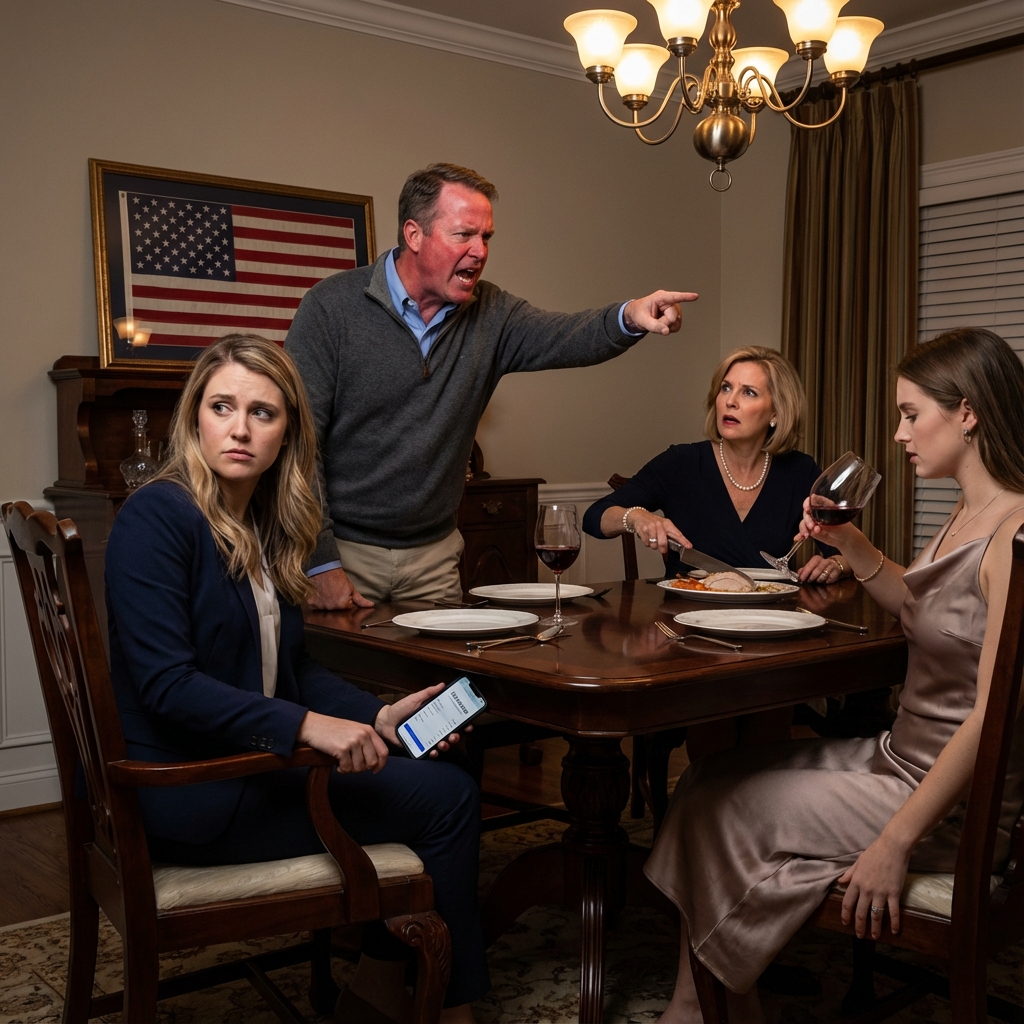
Sloan ran forward, shoving her phone in my face.
“You’re going to jail!” she yelled. “I’m sending this to the news. Channel 5 is on their way.”
As if on cue, a news van pulled into the driveway.
But it wasn’t the fluff piece Sloan expected.
A reporter jumped out, followed by a cameraman. They made a beeline for the group.
“Sloan Whitaker?” the reporter called, thrusting a microphone toward her. “We saw your video online. We have questions about the allegations that you used a fraudulently obtained credit card to pay for your launch party at Marblin & Line. We have a statement from the venue claiming the card was flagged for identity theft.”
Sloan lowered her phone. The color drained from her face.
The camera she loved so much was finally turned on her.
But the lens wasn’t filtering for beauty.
It was filtering for truth.
“I—I have no comment,” Sloan stammered, backing away. “Turn that off!”
The mask had fallen.
The neighbors were no longer looking at a victimized family.
They were looking at a group of grifters who had been caught.
Mrs. Gable slowly turned and walked back to her car.
The pastor checked his watch and slipped away.
The audience was leaving.
I turned back to Dale.
He slumped on the stairs—a broken man.
“Here’s the deal,” I said.
I pulled a single document from my bag.
“This is a mutual release and non‑disclosure agreement,” I said. “And this is a surrender of possession.”
I held them out.
“You sign these now. You hand over the keys. You agree to stop the defamation, stop the lawsuits, and stop contacting me. You leave the house today as ordered.”
“And if I don’t?” Dale whispered.
“If you don’t,” I said, nodding toward Ethan’s briefcase, “Ethan walks this file into the sheriff’s office and you leave here in handcuffs. Federal fraud charges carry mandatory minimum sentences, Dale. Do you want to spend your sixties in a cell, or do you want to walk away?”
Dale looked at the house.
He looked at Cynthia, weeping silently into her hands.
He looked at Sloan, hiding behind a pillar from the news crew.
He looked at me—and for the first time, he saw me not as a wallet, not as a background character, but as the person who had beaten him at his own game.
“Where will we go?” he asked. His voice was small.
“Sign,” I said.
He took the pen. His hand shook violently.
He signed the surrender.
He signed the NDA.
He handed the pen to Cynthia. She signed too.
Then he reached into his pocket and pulled out the heavy brass keyring—the keys to the kingdom.
He dropped them into my open hand.
“Get out,” I said softly.
They didn’t argue.
They didn’t scream.
They walked to their cars—hastily packed with whatever they could cram inside—and drove away.
Sloan peeled out, hiding her face.
Dale drove slowly, not looking back.
The sheriff tipped his hat to me.
“I’ll secure the perimeter, Ms. Alvarez,” he said. “The house is yours.”
“Thank you, Sheriff,” I said.
I walked up the steps.
I unlocked the front door and stepped inside.
The house was silent. The furniture still there—the expensive sofas, the art, the pretension.
It meant nothing to me.
I walked through the kitchen, past the marble counters where I’d been yelled at, past the dining table where I’d been humiliated.
I walked straight to the garage.
I hit the button on the wall.
The heavy door rumbled up, letting in gray light.
There, piled in the corner next to the lawn mower, were six black trash bags.
My life.
My college diploma.
My winter coats.
The books I loved.
I walked over and untied the first bag.
I pulled out a sweater. It smelled of gasoline and dust.
But it was mine.
I didn’t cry.
I felt… light.
I wasn’t taking the house.
I was taking the trash bags.
I carried them out one by one and loaded them into the trunk of my rental.
Ethan walked out to the driveway as I closed the trunk.
“What do you want to do with the house?” he asked.
“Put it on the market,” I said. “Sell it. Liquidate it. Use the proceeds to pay off the legitimate creditors. Donate the rest to a charity for financial literacy.”
“And them?” Ethan asked, nodding down the road where my family had vanished.
“They’re homeless now, Melody.”
I reached into my pocket and pulled out a slip of paper.
“Give this to Arthur Henderson,” I said.
Ethan looked at the paper.
It was an address for a townhouse complex three towns over.
“What’s this?” he asked.
“I prepaid the rent for one year,” I said. “It’s a two‑bedroom. Clean. Safe. Not luxury. No pool. No country club nearby.”
“You’re giving them a home?” Ethan asked, surprised.
“I’m giving them a baseline,” I said. “I’m giving them exactly what they gave me: a roof and nothing else. No cash. No credit cards. No status. Just a chance to survive if they actually get jobs.”
I looked back at the mansion one last time.
It looked like a mausoleum.
“I didn’t want to destroy them, Ethan,” I said. “I just wanted to stop being the foundation they stood on. From today on, everyone stands on their own two feet.”
I got into the car.
I didn’t look back at Cedar Ridge.
I turned the GPS to ‘Home’—not this place, but the villa in Florida, where the air was clean and the ocean was waiting.
I was Melody Alvarez.
I was no longer just a daughter, a victim, or a savior.
I was free.
And as I drove down the highway, passing the green sign that read NOW LEAVING CEDAR RIDGE, I finally turned on the radio and let the music play.
Thank you so much for reading this story. I’d love to know where you are tuning in from—are you reading from a busy city, a quiet room, or maybe on your commute home? Let me know in the comments so we can connect.

Yo Make również polubił
Unikalny tytuł: „10 sygnałów, że pijesz za mało wody – Twój organizm daje Ci znaki”
Pudding chia to najlepszy deser na odchudzanie, a do tego smakuje wyśmienicie
6 rzeczy, które zmieniają się, gdy tracisz rodziców
Człowieku, cały czas robiłem to źle