
Friday never came.
That first three hundred dollars was the first brick in the wall that would eventually crush me.
Over the next decade, the requests shifted from utilities to image maintenance, and the amounts grew from hundreds to thousands.
I was good at my job at Northvale. My specialty was systems optimization. I looked for inefficiencies in supply chains—trucks driving empty miles, warehouses stocking the wrong inventory, routes that wasted fuel—and I fixed them. I turned chaos into order. Loss into profit.
Without realizing it, I applied the same logic to my family. I saw them not as a group of people, but as a failing corporation in desperate need of a restructuring manager. The Whitaker family was a project to prevent collapse. I became the structural support beam that nobody bothered to paint or decorate, but everyone relied on to keep the roof from caving in.
My mother, Cynthia, was a master of the weaponized crisis. She never asked for money directly. That would have been too crude. Instead, she dealt in hysteria.
I remembered a Tuesday afternoon three years ago. I was in the middle of a meeting with a regional distribution manager when my phone vibrated. It was Cynthia. I sent it to voicemail. She called again immediately. Then a third time.
Terrified someone was in the hospital, I stepped out of the conference room and answered.
“They’re declining it, Melody!” she sobbed, her breath coming in short, jagged gasps. “The card. The blue one. The machine is making that awful beeping noise and the woman is looking at me like I’m a criminal.”
“Mom, calm down,” I whispered, huddled in the hallway. “Where are you? Is it the pharmacy?”
“I’m at the bridal salon,” she wailed. “We’re putting the deposit down for Sloan’s debutante renewal ball dresses. The lady says if we don’t pay the four thousand now, we lose the slot for the custom fittings. The Grahams are right behind me in line. Melody, please. I can’t face them. If I have to walk away, I’ll die. I will actually die right here on this carpet.”
It was absurd. It was manipulative. But in that moment, her panic triggered my programming.
Problem: Mom is about to be publicly humiliated.
Solution: Transfer funds.
“Use the card ending in four‑five,” I said, my voice dull. “I just moved money onto it.”
The sobbing stopped instantly.
“Oh, thank God. You’re a lifesaver, sweetie. I have to go. The manager’s coming back.”
She hung up.
No “I love you.” No “I’ll pay you back.” Just a transaction completed, a crisis averted, an image preserved.
I went back into my meeting and successfully negotiated a fifteen‑percent reduction in shipping costs for our client. I saved the company thousands that afternoon. Meanwhile, my own bank account bled out to pay for silk and tulle I would eventually be criticized for not appreciating enough.
Then there was Sloan.
If I was the infrastructure, Sloan was the billboard.
My parents decided early that Sloan was the star—the one who would marry well or become famous, thereby “validating” the Whitaker name. But stardom, or the simulation of it, was expensive.
I paid for the PR classes she took in Nashville, where she learned how to craft a personal brand but not how to balance a checkbook. I paid for the networking trips to Aspen and Miami, which were essentially excuses to drink champagne and take photos for social media.
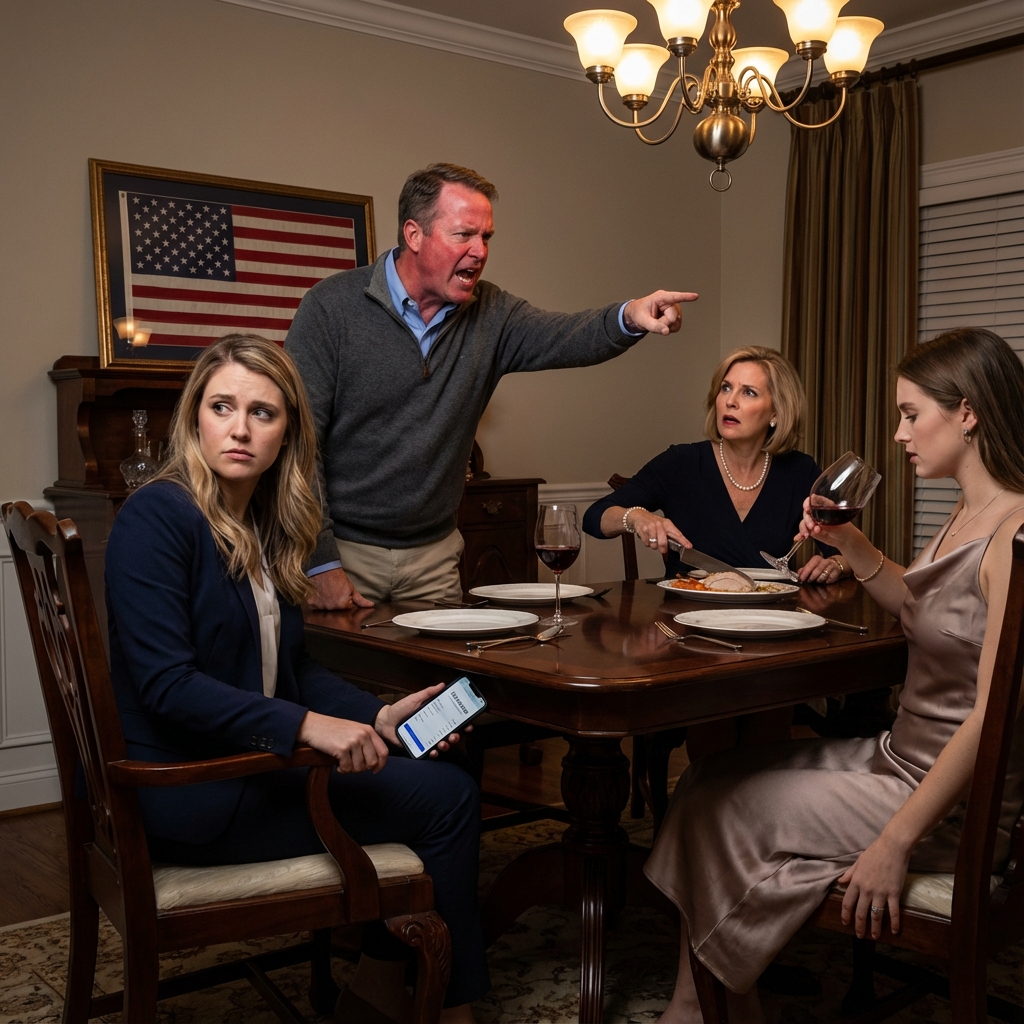
“It’s an investment,” Dale would say, gesturing vaguely at Sloan as she unpacked designer luggage I had purchased. “You have to spend money to make connections, Melody. You’d understand if you got out more.”
I looked down at my own shoes—sensible loafers from a discount store, scuffed at the toes. I drove a sedan with one hundred forty thousand miles on the odometer. I brought a turkey sandwich to work every day in a reusable container because buying lunch cost twelve dollars, and I needed that twelve dollars to cover the interest on the credit card Dale had maxed out under my name for “emergency” golf club repairs.
The disparity was grotesque, but for years I refused to see it clearly.
I told myself it was my duty. I told myself I was the responsible one.
But beneath the layer of self‑righteous responsibility lay a darker, colder truth: I was afraid.
I was terrified that if I stopped paying, I would cease to exist to them. I wasn’t buying their love—I knew deep down that love wasn’t on the table. I was paying a membership fee. I was paying rent for the space I occupied in their minds.
As long as I was useful, they had to keep me around. They had to invite me to Christmas. They had to let me sit at the far end of the table.
If the money stopped, I vanished.
The house in Cedar Ridge was a monument to this lie. The furniture was changed every eighteen months to keep up with whatever trend Cynthia saw in Architectural Digest. We went from Tuscan farmhouse to modern industrial to French country, bleeding cash with every transition.
Meanwhile, my apartment—before I moved back “to save them money” on the promise of eventually owning a stake in the house—was sparse. I denied myself everything. I wore clothes until they frayed. I never took vacations. I convinced myself I didn’t like travel, that I didn’t like nice things.
It was a survival mechanism. If I didn’t want things, I wouldn’t resent giving my money to them.
But the logistician in me couldn’t be entirely suppressed. I loved data. I loved records.
Five years ago, I started a spreadsheet. It was password‑protected, hidden deep within a nested folder structure on my personal laptop. I named it “family_support.xlsx.”
Every time I paid a bill, transferred cash, covered a loan payment, or paid off a credit card balance that wasn’t mine, I entered it into the sheet.
Date. Recipient. Category. Amount. Notes.
November 14 – Cynthia – Nordstrom – personal shopper – $3,200. Note: She said it was for Dad’s anniversary gift. Bill shows three ladies’ handbags.
January 3 – Dale – Audi lease payment – $890. Note: He promised to pay back on the fifteenth. Never mentioned it again.
March 22 – Sloan – “crisis management” – $5,000. Note: She backed her car into a parked BMW and didn’t want insurance to know.
I entered the data religiously. It was my way of screaming in a soundproof room.
There was only one thing I never did.
I never scrolled to the bottom of the spreadsheet. I never created a sum total cell. I was afraid of the number. I felt that if I saw the actual cumulative cost of my family’s affection, the sheer weight of it would snap my spine.
I preferred the vague, aching heaviness of “a lot” to the sharp, undeniable reality of a specific figure.
Sitting in the jet, miles above the earth, I opened my laptop. The screen was bright in the dim cabin. I bypassed the encrypted partition where my Root Warden fortune was stored. That money was clean. That money was mine.
I went to the old folder. I opened the spreadsheet.
It took a moment to load. The rows went on for thousands of lines. Ten years of bleeding. Ten years of being the background character in my own life so they could play the leads.
I highlighted the column labeled “Amount.” I clicked the auto‑sum button.
The figure appeared in the bottom right corner.
It wasn’t just money. It was time. It was the vacations I didn’t take. It was the dates I didn’t go on because I couldn’t afford a nice dress. It was the house I didn’t buy for myself five years ago. It was my self‑esteem, liquidated and transferred into their accounts to purchase an illusion of success.
Three hundred forty‑two thousand eight hundred ninety‑four dollars.
That was the direct cash. That didn’t include the interest I had paid on the loans I took out in my name to cover their debts. It didn’t include the opportunity cost of not investing that money.
I stared at the number.
I should have felt sick. I should have felt rage.
Instead, I felt a cold, hard clarity.
This wasn’t a family. It was a parasitic organism, and I had been the host.
My mother’s tears weren’t expressions of sadness. They were transaction requests. My father’s praise wasn’t pride. It was a receipt for payment received. Sloan’s mockery was the behavior of a spoiled customer complaining about the service while refusing to pay the bill.
I closed the laptop with a snap.
“Can I get you anything else, Ms. Alvarez?” the flight attendant asked, stepping softly into the cabin.
“No, thank you,” I said. My voice was steady. “I have everything I need.”
I looked out the window at the dark expanse of the Atlantic coast below.
I had spent my life thinking I was buying love, or at least buying safety.
I was wrong.
I had been paying a fee to be tolerated. Paying for the privilege of being the punching bag they could lean on when they were tired.
But that contract was void now.
I had walked out, and unlike them, I had kept the receipts.
The realization settled over me, heavier than the G‑force of takeoff.
They thought they had discarded a daughter. They didn’t understand they had actually defaulted on a creditor.
And in the world of business, which Dale claimed to love so much, when you default on a creditor who holds all the data, you don’t get to walk away.
You get liquidated.
I shifted the gear stick into park. The engine of my sedan idled with a rough shudder that vibrated up through the steering wheel.
I was not at a hotel. I was not at a friend’s house.
I was parked in front of Unit 402 at the Easy Access Self Storage facility on the edge of town, a place that smelled of damp concrete and industrial cleaner. The kind of anonymous storage row you see off every interstate in America, wedged between a Waffle House and a used car lot.
This was my real closet.
Three years ago, my mother had decided my bedroom in the main house—the one I had occupied since childhood—was “too cluttered.” She needed the space. She said she wanted to turn the adjoining walk‑in closet, technically mine, into a “meditation nook” for herself. A place to center her chakras while I paid the electric bill that powered her essential oil diffuser.
“You don’t need all these winter coats and old college books here, Melody,” she had said, waving a manicured hand. “It disrupts the flow of chi. Just move them out. It’s temporary.”
It wasn’t temporary. It was an eviction by degrees.
“Move the coats” turned into “move your desk,” which turned into “move your file cabinets.” Eventually, almost everything I owned that had any personal density—my journals, my college awards, my winter gear, my actual life—ended up here in a ten‑by‑ten corrugated metal box I paid eighty‑five dollars a month for.
I got out of the car. The humid Tennessee night air stuck to my skin. I punched my code into the keypad. The gate rattled open with a sound like grinding teeth.
I rolled up the metal door of my unit. Under the harsh buzz of the single fluorescent bulb, my life looked back at me.
It wasn’t arranged with love. It was stacked—cardboard boxes labeled in my own handwriting, plastic bins filled with the clothes I “wasn’t fashionable enough” to wear at family events.
I was looking for my server backup. I kept a localized encrypted hard drive here, updated weekly, just in case the house ever burned down—or, more likely, my father decided to snoop through my room.
My phone chimed in my pocket, a sharp, piercing sound that cut through the silence of the storage yard.
A multimedia message from Sloan.
My thumb hovered over the screen. I shouldn’t look. I was out. I was free.
But the habit of pain is hard to break.
I tapped the notification.
It was a photo.
The angle was from the doorway of my bedroom—or what used to be my bedroom.
The floor was covered in black plastic trash bags. They were cinched tight, bulging with shapes I recognized: my bedding, the lamp I’d bought with my first bonus, the few clothes I’d left in the closet. Stuck to the side of the largest bag was a strip of masking tape. On it, in Sloan’s looping, bubbly handwriting, was a single word:
GOODWILL.
I swiped to the next photo. It was a close‑up of the hardwood floor near the window. There was a pile of shattered glass and splintered wood.
I zoomed in.
It was the frame of the only picture I had of me and Dale together where he looked genuinely proud—a shot from my high school graduation, before the debts piled up, before I became the bank account.
The glass was pulverized. The photo underneath was torn, a jagged rip running right through my face, separating me from my father.
Then came the text message.
Oops. The frame slipped when we were clearing the shelf. Be careful when you pick this junk up tomorrow. Don’t drag the bags. We just had the floors refinished and I don’t want scratches for the studio reveal.
I stared at the screen.
The pixelated image of the broken glass blurred—not because of the resolution, but because the rage rising in my throat was so hot it made my eyes water.
She didn’t care about the photo. She didn’t care that she was throwing my life into garbage bags like refuse.
She cared about the varnish on the floorboards.
I was not a sister. I was an obstacle that could scratch the finish.
I didn’t reply. I didn’t type out a furious paragraph calling her a monster. I didn’t call Cynthia to beg her to save my things.
That was what the old Melody would have done.
The old Melody would have driven back, apologized, and spent the night on her knees picking glass out of the carpet to save them the trouble.
I turned off the phone screen and tossed it onto the passenger seat of my car.
I walked into the storage unit, stepping over a box of college textbooks. I found what I was looking for: a heavy fireproof safe in the back corner.
I spun the dial, the tumblers clicking familiarly under my fingers. Inside sat a ruggedized laptop and two external hard drives.
I took the laptop to the hood of my car. I didn’t have Wi‑Fi here, but I had a satellite hotspot I kept for business trips. I powered it up. The fan whirred to life, a mechanical breath in the quiet night.
I didn’t log into my bank accounts. I didn’t check my flight status.
I opened the file: family_support.xlsx.
The cursor blinked at the bottom of the long, long list of entries I’d reviewed in my mind on the plane, but seeing it here in the harsh light of the storage facility, with the image of my belongings in trash bags fresh in my mind, it looked different.
It wasn’t just a ledger of debts.
It was a crime scene.
Every row was a moment where I had been erased.
June 12 – Sloan’s car repair – $1,200. That was the month I canceled my dental surgery because “money was tight.”
August 4 – Dale’s club tab – $4,500. That was the week I ate instant noodles for dinner five nights in a row.
I scrolled to the very bottom, past the grand total that had sickened me earlier. I clicked on the first empty cell. My fingers flew across the keyboard, the plastic keys clacking loudly in the empty night.
Date: today. Recipient: the Whitakers. Amount: everything. Notes: tonight – baseline reset.
I hit Enter.
The cell locked into place.
Then I did something I had never done before.
I didn’t just look at my own spreadsheet. I minimized it and opened the raw data export from the joint bank account—the one my name was on, the one I poured money into, but never scrutinized because I trusted them to only use it for “essentials.”
I needed to separate my finances. I needed to know exactly what pending transactions were about to hit so I could stop them.
I scanned the list of transactions from the last thirty days.
Utility board. Supermarket. Gas station.
Normal. Normal. Normal.
Then I stopped.
October 15 – EasyCash Advance – $5,000.
I frowned.
I hadn’t taken out a cash advance. I had plenty of liquidity. Why would I pay the exorbitant fees of a predatory lender?
I looked at the transaction details. It was authorized via a debit card ending in 3‑3‑8.
My hand froze on the trackpad.
I didn’t have a card ending in 338. My card ended in 901.

Yo Make również polubił
Kurczak faszerowany brokułami i serem cheddar
Odkryj moc goździków: naturalny środek odstraszający owady
Mandarynowy deser z ciasta francuskiego z orzeźwiającym napojem mandarynkowym
Mój mąż zerwał ze mną kontakt na trzy lata, jego rodzina kazała mi i mojemu dziecku się wyprowadzić: „Powinniście znaleźć sobie inne miejsce do życia!”. W deszczową noc, trzymając na rękach mojego pięcioletniego syna, czekałam na autobus. Jego starsza siostra podjechała luksusowym samochodem, zatrzymała się tuż przede mną i powiedziała: „Wsiadaj, mam ci coś bardzo ważnego do powiedzenia”.