
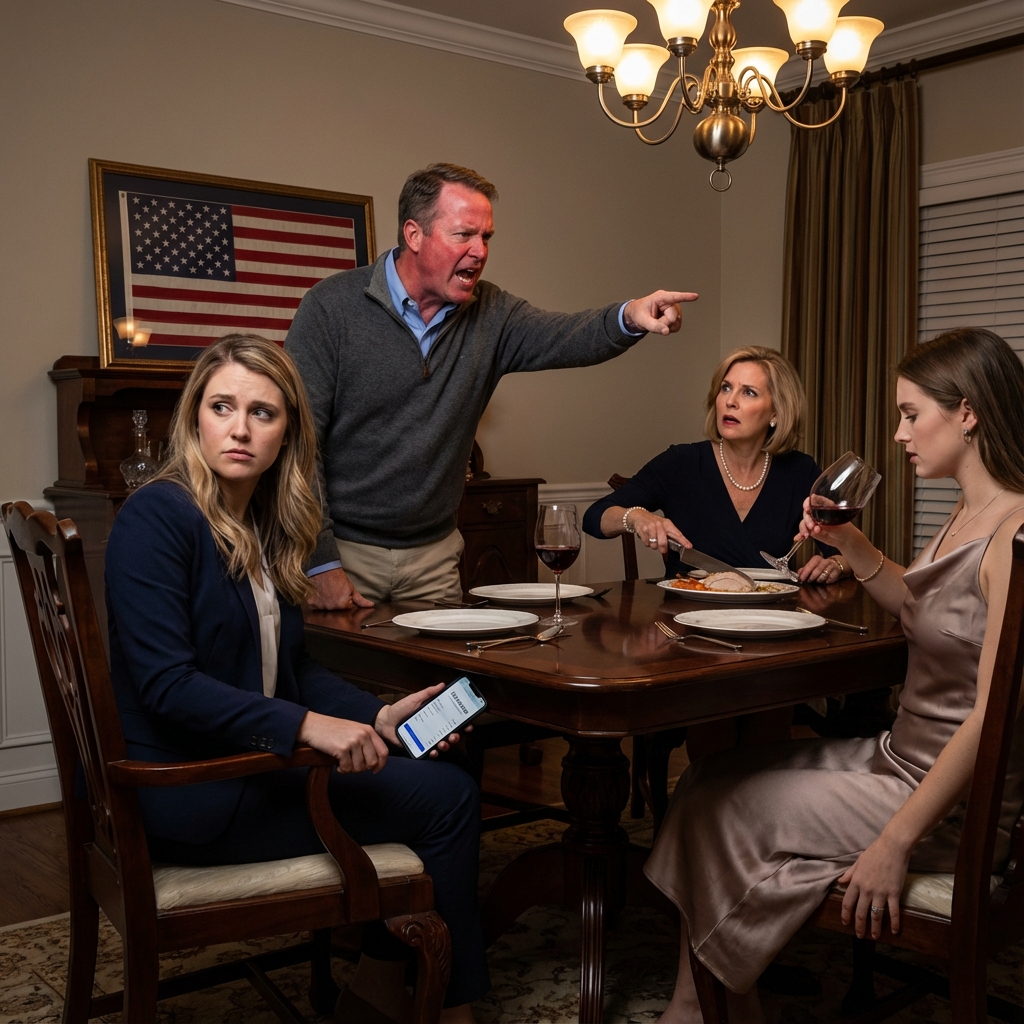
I was out.
And they were just beginning to realize they were trapped inside a house they no longer owned, with a debt they couldn’t pay, fighting a ghost they couldn’t see.
I tapped the steering wheel to the beat of the country song on the radio.
It was a good day for a flight to Florida.
The tires of the black SUV crunched softly over the crushed‑shell driveway of the estate in Port Royal, Naples. This wasn’t a driveway. It was a runway, lined with royal palms standing like sentinels against the blinding blue Florida sky.
I stepped out of the SUV and the first thing that hit me was the air.
It didn’t smell like the stagnant, humid desperation of Cedar Ridge.
It smelled of salt, iodine, and jasmine.
It smelled like ninety million dollars.
I looked up at the house.
To call it a house was an insult to architecture.
It was a sprawling masterpiece of glass, steel, and white travertine stone, designed to look as if it were floating above the water. Twenty‑two thousand square feet of absolute silence and control, perched on a private slice of the Gulf Coast.
I had bought it six months ago through a blind trust after the Root Warden sale, but I had never slept here. I’d kept it empty—a secret escape pod waiting for the day I finally ejected myself from the cockpit of the Whitaker family crash site.
That day was today.
A woman in a crisp white linen suit stood by the massive pivot door.
This was Elena, the luxury broker who had handled the transaction. She smiled as I approached—a real smile, not the shark‑like grin of the social climbers my father collected.
“Welcome home, Ms. Alvarez,” Elena said, extending a hand. “The staff has stocked the kitchen as requested. The smart home systems are online. The beach is…” She glanced over my shoulder at the glittering water. “Well. The beach is perfect.”
I shook her hand.
“Thank you, Elena.”
We walked inside.
The foyer was a cavern of light, the ceiling soaring thirty feet high. Through the floor‑to‑ceiling glass walls at the back, the Gulf of Mexico stretched to the horizon, a flat sheet of turquoise glass.
“It’s breathtaking,” Elena said, watching me stare at the view. “You know, when I read the article about the Root Warden acquisition in Forbes, I wondered if you’d buy in Silicon Valley. I’m glad you chose Naples. We need more innovators here instead of just retirees and hedge‑fund guys.”
I stiffened slightly.
It was still jarring to hear a stranger acknowledge the reality of my life—the successful tech entrepreneur—when, for the last decade, the people who supposedly loved me only saw a “mid‑level logistics manager” with a convenient checkbook.
“I needed distance,” I said, walking toward the glass. “Silicon Valley is too loud. This is quiet.”
Elena nodded, sensing the subtext.
“I assume your family will be joining you soon?” she asked gently. “There are nine bedrooms, after all.”
I looked at the ocean.
I thought about the trash bags in the Tennessee garage. The red‑bordered letter sitting on my mother’s kitchen counter.
“No,” I said quietly. “My family doesn’t know about this place. They don’t know about Root Warden. They don’t know about the money.”
Elena’s eyebrows lifted slightly, but she was a professional. She recovered quickly.
“I see,” she said. “They must be very… disconnected.”
“They only know me when they need a wallet,” I said. “And the wallet is closed.”
Elena handed me a final key card, a sleek piece of heavy metal.
“Well then,” she said, “enjoy your sanctuary, Ms. Alvarez. It’s all yours.”
When she left, the silence rushed in to fill the space.
But it wasn’t the heavy, accusatory silence of the Whitaker dinner table.
It was a clean, expansive silence.
The sound of freedom.
I walked to the kitchen island, carved from a single block of marble. I pulled my phone from my purse.
It vibrated—a constant, angry buzz.
Dad. Mom. Sloan. Dad. Dad.
I looked at the screen one last time.
Then I pressed the power button and held it down.
The screen went black.
For the first time in twelve years, I was offline.
I did not spend the next twenty‑four hours crying. I did not pace the floor, worrying if my mother had fainted or if my father had had a stroke.
I spent them swimming.
The infinity pool blended seamlessly with the ocean, the vanishing edge making it feel like I could float out into the Gulf. I swam laps until my muscles burned, washing away the feeling of that house—the feeling of being small.
I ate fresh seafood on the terrace, watching the sun sink into the Gulf, painting the sky in violets and golds. I slept in a bed that cost more than Sloan’s car, wrapped in sheets that felt like clouds.
I didn’t dream of anything.
When I woke the next morning, the sun streamed through the automated blinds. I felt recharged.
The emotional daughter was gone.
The CEO was present.
I went to the study, a room with a view of the private dock, and powered up my workstation. I took my phone out of the drawer and turned it on.
It took three full minutes for the device to stop seizing as notifications flooded in.
Forty‑seven missed calls. Eighty‑two text messages. Twelve voicemails.
I ignored them all and dialed Ethan.
“You’re alive,” he said. “I was beginning to think you drowned in the pool.”
“I took a personal day,” I said. “Status report?”
“Chaos,” Ethan said. “Absolute, unmitigated chaos. Dale called my office five times. He somehow figured out Seawall Capital is represented by my firm—though he doesn’t know you’re the principal. He was screaming at my paralegal, demanding to speak to the ‘manager’ of the fund.”
“What did you tell him?” I asked.
“I told him Seawall Capital is an institutional investor that enforces strict asset performance protocols,” Ethan said. “I told him the loan is in default and the acceleration clause has been triggered. He tried to offer a payment plan. Said he could pay ten thousand a month.”
I laughed, a dry, humorless sound.
“He doesn’t have ten thousand a month.”
“Exactly,” Ethan said. “I told him we don’t do payment plans on defaulted notes with evidence of collateral impairment.”
“Did he ask what that meant?”
“He did,” Ethan said. “I told him we’re aware of the secondary liens and the irregularities with the guarantor.”
“Did he panic?”
“He went silent for ten seconds,” Ethan said. “Then he hung up. But that’s not the best part. Have you checked social media? Your sister has been busy.”
“I haven’t looked,” I said.
“You should,” Ethan replied. “She’s trying to spin the narrative, but she’s not very smart.”
I hung up and opened my laptop.
I navigated to Sloan’s Instagram profile.
There was a new video posted six hours earlier. It already had four thousand views.
The thumbnail showed Sloan, teary‑eyed, wearing a hoodie—a calculated costume change from her usual designer wardrobe, designed to make her look “relatable” and victimized.
I clicked play.
“Hey guys,” Sloan whispered, wiping at a dry eye. “I know I usually post about wins and success, but today is really hard. I just wanted to be real with you. My family is under attack.”
She sniffled loudly.
“My sister—I can’t even say her name right now. She abandoned us. She literally walked out when we needed her most. And now some predatory vulture fund is trying to take our childhood home. They sent this letter.”
She held up the red‑bordered notice from Seawall Capital.
“They’re saying we owe all this money immediately, which is impossible. It’s just so unfair. We are good people. My dad has worked so hard. And my sister? She’s probably off somewhere laughing. It’s just—it’s evil.”
I paused the video and leaned in closer.
She was holding the letter up to the camera to show the threatening red border—but the resolution of the video was 4K, and Sloan, in her desire to be believed, hadn’t blurred the text.
I took a screenshot and zoomed in.
The paragraph she’d been flaunting was the schedule of collateral.
It listed the Cedar Ridge property.
And right below it, clearly legible, it listed: 50% beneficial interest in Blue Heron Holdings – Riverbend Development.
I sat back, stunned.
She had just published the existence of the hidden asset to the entire internet.
But that wasn’t all.
I looked at the comment section.
User: @KnoxvilleRealtor – Wait, Blue Heron Holdings… isn’t that the land near the national park that’s been tied up in environmental lawsuits for 2 years?
User: @BankerDave – Why is there a demand for $480k? I thought you said your dad owned the house outright in your last Q&A?
User: @CreditorWatcher – If they’re defaulting on a hard money loan, they’re insolvent. @Marblin&Line, didn’t you just promote her to VP? Do you let insolvent officers handle luxury accounts?
She had tried to launch a smear campaign against me.
Instead, she had doxxed their own financial ruin. She had revealed the hidden asset to any other creditors they might have. She had publicly contradicted her own wealthy‑heiress brand.
I didn’t feel angry.
I felt like a logistician watching a truck driver drive off a cliff because he refused to look at the map.
Data over emotion, I reminded myself.
I saved the video. Archived the comments. Took screenshots of every frame where the letter was visible.
If Dale tried to deny he owned the Riverbend land during foreclosure proceedings, I now had a video of his daughter broadcasting it to the world.
My phone rang again. The caller ID showed a generic number.
I answered.
“This is Melody.”
“Ms. Alvarez.” A male voice boomed, trying too hard to sound authoritative. “This is Arthur Henderson. I represent Dale and Cynthia Whitaker.”
Arthur Henderson. I remembered him. A golf buddy of my father’s who handled DUIs and simple wills. He was out of his depth in a parking ticket dispute, let alone a complex foreclosure.
“Hello, Arthur,” I said pleasantly.
“Now listen here, Melody,” Arthur blustered. “I’ve heard some very disturbing things. Your father tells me you’ve absconded with family funds and are refusing to assist in a time of crisis. He’s considering filing a civil suit for abandonment and emotional distress.”
“Abandonment is not a cause of action for a thirty‑four‑year‑old woman, Arthur,” I said mildly. “And as for ‘family funds,’ I have receipts for every dollar I ever gave them. Would you like to see the spreadsheet? It totals nearly three hundred fifty thousand.”
Arthur stammered.
“Well, that’s a matter for discovery, but right now we’re concerned about this Seawall Capital. Your father believes you have some connection to them. He thinks you’re behind this.”
“He thinks a logistics manager is behind a private equity firm?” I asked. “That gives me a lot of credit.”
“Melody, if you’re found to be conspiring to defraud your parents—”
“Defraud?” I cut him off, my voice dropping an octave. “Let’s talk about fraud, Arthur. Let’s talk about a loan application to Apex Private Lending, signed by ‘Melody Alvarez’ two years ago when I was in Chicago for a conference. Let’s talk about the IP log showing that the digital signature came from the Cedar Ridge house.”
Silence.
Dead silence.
“I’m the one with the evidence, Arthur,” I continued. “I suggest you advise your clients to focus on the demand for payment they received. Seawall Capital does not look like the kind of entity that plays games.”
“We will contest the foreclosure,” Arthur said, but the bluster was gone. He sounded scared. “We’ll file an injunction.”
“You can try,” I said. “But tell Dale this: if he sues me, I will countersue. And I will file criminal complaints regarding the identity theft. Is he ready for that deposition? Is he ready to explain to a judge why he forged his daughter’s name to pay for a vacation to Cabo?”
Arthur cleared his throat nervously.
“I’ll speak with my clients.”
“You do that,” I said. “Have a nice day, Arthur.”
I hung up.
I walked out to the terrace.
The ocean was still there—vast and indifferent.
They were going to fight, of course.
They were cornered animals.
But they were fighting with dull claws.
I was fighting with a nuclear arsenal of documentation.
“Let them sue,” I said to the wind. “Finally, we’re playing by the rules.”
I sat on a lounge chair and opened my Kindle.
I had a lot of reading to do.
For the first time in my life, I had absolutely nowhere else I needed to be.
The villa wasn’t just a home.
It was a fortress.
And the siege had just begun.
The legal complaint arrived electronically—a thirty‑page PDF that hit my inbox with the dull thud of a bureaucratic hammer.
Dale Whitaker v. Seawall Capital LLC.
I sat in my study in Naples, scrolling through the document.
It was a masterpiece of fiction.
My father, through his inept lawyer Arthur, was suing to enjoin the foreclosure. The narrative they constructed was breathtaking in its audacity.
They claimed Seawall Capital was a “vulture fund” acting in bad faith. That the default was a result of a technical error by the previous lender. That acceleration of the debt caused “undue emotional distress” to a pillar of the Cedar Ridge community.
They asked for a temporary restraining order to stop the sale of the house and a jury trial to determine damages.
It was the legal equivalent of throwing sand in the umpire’s eyes to buy time.
I picked up the phone and called Ethan.
“I’m reading the complaint,” I said. “He’s accusing Seawall of predatory practices.”
“It’s a standard stall tactic,” Ethan said, sounding bored. “He’s trying to drag this out past the thirty‑day window so he can find another lender to refinance. But he’s making a fatal mistake.”
“Which is?”
“He filed a sworn affidavit stating that he was solvent and capable of payment but for the bank’s error,” Ethan said. “He put that in writing under penalty of perjury.”
I looked at the framed document on my desk—the Minutes of Family Financial Meeting I’d tricked Dale into signing days earlier.
“And we have a document signed by him forty‑eight hours before that filing,” I said, “where he admits he’s insolvent and soliciting seventy‑five thousand from me to avoid ruin.”
“Exactly,” Ethan said. “He just perjured himself in the opening round. We don’t need a trial, Melody. We need a summary judgment hearing. I’ll file a motion to dismiss his injunction based on unclean hands and demonstrable perjury. I’ll attach the minutes.”
“Do it,” I said. “Destroy the narrative.”
While Ethan sharpened the legal guillotine, the emotional war continued on another front.
The mail that afternoon brought a physical letter.
The envelope was pink, scented with the perfume my mother had worn since I was a child—a scent that used to mean safety but now smelled like manipulation.
I opened it.
The handwriting was shaky, the ink slightly smeared as if by tears.
My dearest Melody,
I don’t know what has gotten into you. Your father is beside himself. We are under attack by this horrible company and you are nowhere to be found. But I know you, sweetie. I know you have a good heart. I know you aren’t this cold, unfeeling person you are pretending to be.
Please come home. If you transfer the money to cover this mess, I will make sure your father forgives you. I will tell everyone what a savior you are. We can go back to how it was.
Just fix this and I will love you like I always have.
Love,
Mom
I read the letter twice.
If you transfer the money, I will love you.
It was the most honest sentence she had ever written.
Her love was conditional.
It was a service I had to purchase.
I put the letter down and turned back to my computer.
Ethan’s team had been conducting a forensic sweep of the financial discovery materials we’d legally compelled Apex to turn over, along with a deeper credit trace on the “Melody Alvarez” profile.
There was a flagged file in the folder titled “Unauthorized Accounts.”
I opened it.
It was a credit card statement for a Chase Sapphire Reserve.
I didn’t have a Chase Sapphire Reserve.
I looked at the application data. It was opened eighteen months ago. The social security number was mine. The name was mine.
But the email address used for account alerts was: cynthiadesign@yahoo.
My mother’s old “design consulting” email.
I scrolled through the charges.
It wasn’t construction materials or loan payments.
Botox Center of Nashville – $600.
Total Wine & More – $300.
Pilates Studio Package – $400.
Nordstrom – $800.
My stomach clenched.

Yo Make również polubił
Tylko jedna filiżanka tygodniowo – sekret całorocznego kwitnienia lilii pokojowej
Ekspresowa Szarlotka – Szybki i Smaczny Deser dla Każdego
Najlepsze puszyste pączki 🍩 – delikatne, lekkie i rozpływające się w ustach!
Zredukuj stan zapalny brzucha, pozbądź się tłuszczu i oczyść jelito grube dzięki temu naturalnemu koktajlowi