
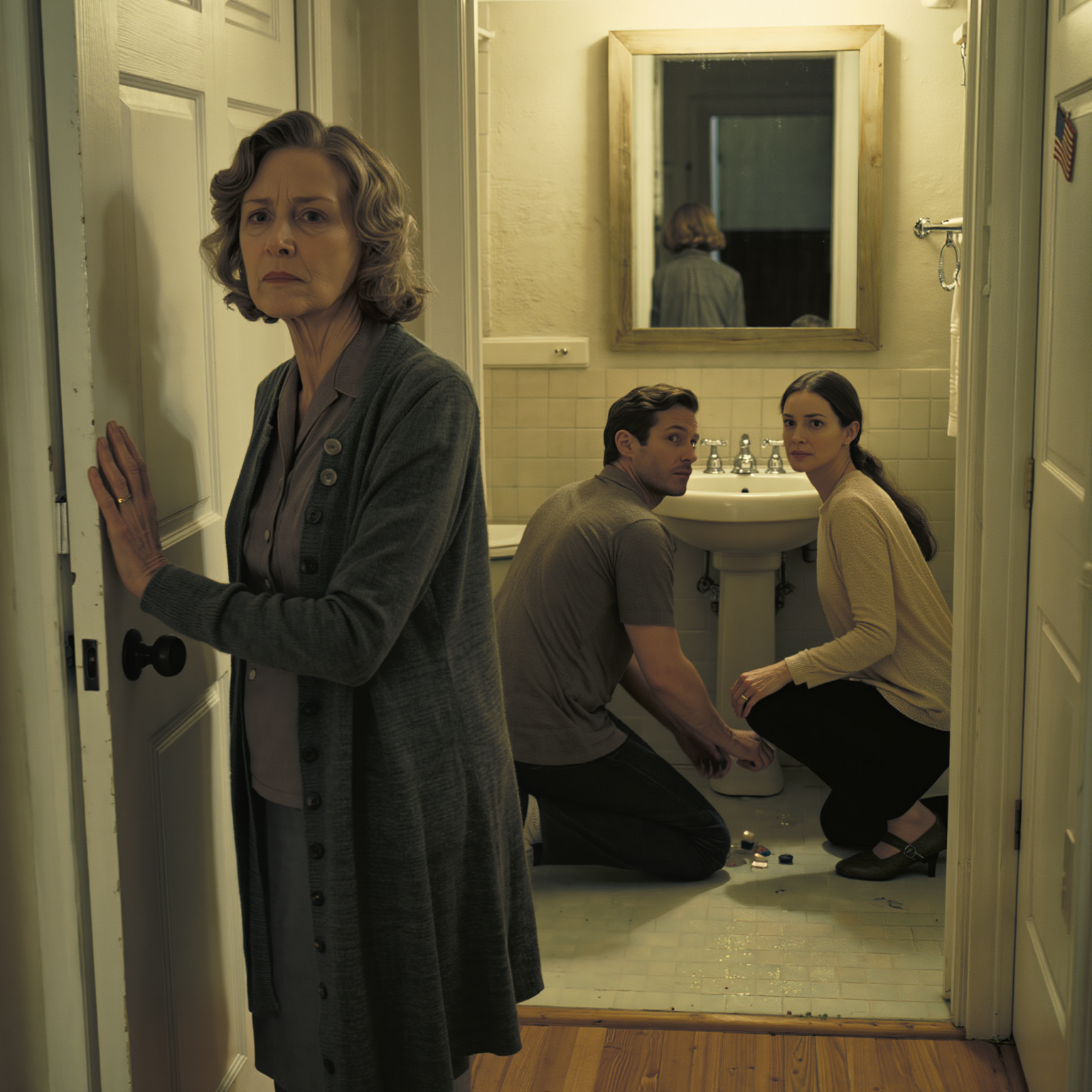
“Dr. Morrison, I know you know exactly what you’re doing. But I need to say this: if at any point this feels like too much risk, we can pull the plug and go straight to the police with what we have. It’s already enough for a serious investigation.”
“I understand,” I said. “But you know as well as I do that there’s a difference between a strong suspicion and an attempt caught on camera. I want them caught in the act. I want a jury to see what they did, not just hear about it.”
He nodded once.
“Then we’ll give you that.”
Over the next three weeks, my house became the quiet center of a storm only a handful of people knew about.
We caught everything.
On Day Three, Chenise let herself into my house while I was at a doctor’s appointment in Decatur. She thought I was miles away. In reality, I was parked around the corner, watching a live feed on my phone.
She went straight to my office, opened drawers, and pulled out old letters—birthday cards, Christmas cards, handwritten notes. She spread them on my desk and spent twenty minutes practicing my signature on a yellow legal pad.
Her hand moved slowly at first, then more confidently. Loop, loop, line. She tilted her head, comparing the forgery to the original. Then she tried again.
Every stroke was captured by the hidden camera in the curtain rod.
After that, she went to the bathroom, opened my medicine cabinet, and took each pill bottle out one by one, photographing the labels with her phone—dosage, drug name, prescribing physician.
On Day Five, Cameron’s surveillance on the outside caught something else.
He’d arranged for Marcus’s car to get a “special” oil change at a shop owned by a friend. While the car was on the lift, a technician installed a tiny audio bug under the dashboard.
Later, Cameron sent me the recording.
The sound of mugs clinking and a milk steamer hissing filled the background. They were in some trendy Atlanta coffee shop.
“Marcus, I’ve been researching the meds your mom takes,” Chenise said. “Her blood pressure pills and that anxiety medication—taken together, they can cause dizziness, drowsiness, confusion.”
“So we make sure she’s taken both before we set up the scene,” Marcus said.
“Exactly,” Chenise replied. “We’ll crush some of the pills and put the powder in her water bottle. She always drinks water after church. By the time she gets home, she’ll be groggy. That’s when we move. The fall will look completely accidental.”
“You’re sure?” Marcus asked. “You’re absolutely sure?”
“Marcus,” she said, “elderly people fall in bathrooms all over America every day. Wet floor, slippery tile, medications—it’s one of the leading accidental death scenarios in her age group. No one is going to question it. Trust me.”
I sat at my desk and listened to that recording twice.
Then I forwarded it to Raymond and Detective Williams.
On Day Eight, Cameron tailed them to a high-rise office building in Buckhead. They met with a financial advisor in a glass-walled office with a view of the Atlanta skyline.
Cameron set up a directional microphone outside on the public sidewalk, within legal limits.
“So you’re expecting a significant inheritance relatively soon?” the adviser asked.
“Yes,” Chenise said. “Marcus’s mother is older. We expect she’ll pass within the next month or two.”
“Is she ill?” the adviser asked.
Marcus lied without hesitation.
“She’s been declining,” he said. “Her health isn’t good. She lives alone, big house, lots of stairs. We’re… preparing.”
“We’re talking about around $2.4 million,” Chenise added. “House, retirement accounts, some land. We want to make sure we handle it the right way. Taxes, investments, all of that.”
They were planning my money as if I were already in the ground.
Cameron also pulled their financial records. Between credit cards, car loans, and a few quiet personal debts, they were more than $35,000 under water.
They weren’t just greedy.
They were desperate.
On Day Twelve, my hidden cameras caught them back in my house while I was at church.
They walked straight up to my master bathroom like it already belonged to them.
“Three more days,” Chenise said, standing in the doorway, arms folded. “Saturday. She has her women’s ministry from nine to noon, like clockwork. She’s always gone exactly three hours.”
Marcus was pacing.
“So we come over before she gets home,” he said.
“We’re already here when she arrives,” Chenise said. “I’ll have disabled the security cameras. We tell her we stopped by to check on her, make sure she’s okay. She’ll go upstairs to change. She always changes clothes after church.”
It hit me how closely she’d been watching my routines.
“That’s when we make our move,” she continued. “Her water bottle will already be drugged. By the time she’s been home fifteen, twenty minutes, she’ll be out of it.”
“What if she realizes something’s wrong?” Marcus asked. “What if she fights?”
“She’s sixty-seven,” Chenise said coldly. “She’ll be drugged and dizzy. We help her to the bathroom because she doesn’t feel well. The floor’s already wet. The rug is positioned. We steer her to the right spot.”
“How hard do we… push?” Marcus asked quietly.
“Hard enough,” she said. “We need a significant head injury. It will look like she slipped, fell, hit her head on the tub edge. Accident. End of story.”
Later that night, I watched that footage in my living room with Raymond and Cameron. My dog-eared Bible sat on the coffee table like a small, calm anchor amid the chaos.
“This is first-degree murder,” Raymond said, his jaw tight. “Premeditation, planning, financial motive, conspiracy. We’ve got them.”
“Not yet,” I said. “We need them to actually attempt it. Juries don’t always understand planning. They understand hands on a victim.”
Cameron nodded slowly.
“Saturday,” he said. “Three days from now. We’ll be ready.”
We spent Thursday and Friday planning our own operation.
On Thursday, I drove downtown to Atlanta Police headquarters and met Detective Kesha Williams in a conference room that smelled faintly of coffee and printer ink.
She was in her forties, with tired, intelligent eyes and a posture that said she’d seen more than enough of the worst parts of humanity.
I laid it all out: the video clips, the audio recordings, the financial documents. She watched the footage of Marcus and Chenise practicing my death in my bathroom and didn’t say a word until it ended.
When the screen finally went dark, she looked at me.
“Dr. Morrison,” she said, “this is the most thorough pre-attempt case I’ve ever seen. If I didn’t know better, I’d think you were building training material.”
“In a way, I am,” I said. “This time I’m the exhibit.”
“You’re sure you want to let them move forward?” she asked. “Actually attempt it?”
“Yes,” I said. “With conditions. I want officers nearby. I want surveillance. I want my own safety prioritized. But I also want them caught in the act so completely that no jury member can wriggle out of the verdict.”
“What protections do you want in place?” she asked.
“First,” I said, “I’ll wear a hidden body camera and an audio recorder on Saturday. Second, I want undercover officers positioned around my house—close enough to get inside within thirty seconds of a signal. Third, I want Raymond and Cameron in a surveillance van nearby, monitoring everything. Fourth, I’ll swap the water bottle they plan to drug with a decoy filled with harmless vitamin powder that looks like crushed medication. I will not actually be drugged.”
“And what will your signal be?” she asked.
“When they try to force me down in the bathroom,” I said, “I’ll say, loudly and clearly: ‘You’re really doing this? You’re really trying to kill your own mother?’ That sentence is your cue. The moment you hear it, you come in.”
She nodded slowly.
“This is incredibly risky,” she said.
“I know,” I replied. “But I also know what happens to women my age who try to report things without proof. I want proof. I want this on record from every possible angle.”
“All right,” she said. “Then let’s rehearse the operation.”
We went over it again and again. On Saturday morning, four undercover officers would be positioned outside my house. Two in unmarked cars on my street, blending in with the SUVs and pickup trucks. Two on foot in my backyard and side yard, hidden behind fences and hedges. Raymond and Cameron would sit three houses down in a white utility van full of monitors and wires. Detective Williams would coordinate from a car on the next street over, listening in via radio.

Yo Make również polubił
🧁 Angielskie Babeczki Jogurtowe Light
Ostrzegawcze znaki, których nigdy nie należy ignorować w przypadku skóry
Dlaczego nie warto przywiązywać wstążki do bagażu?
Moja rodzina kazała mi zostać w domu w te święta, bo „nie masz dzieci, to nie zrozumiesz”, usunęła mnie z grupowego czatu i oczekiwała, że będę siedzieć sama w mieszkaniu, podczas gdy oni będą publikować swoje zdjęcia w idealnie dopasowanych piżamach. Dlatego w ostatniej chwili zarezerwowałam pobyt w pięciogwiazdkowym kurorcie na Karaibach, zamówiłam szampana przy basenie, a kiedy zaczęłam wrzucać te selfie o zachodzie słońca i filmy z basenem bez krawędzi, ich pełne poczucia winy telefony i desperackie wiadomości nagle nie chciały się skończyć.