
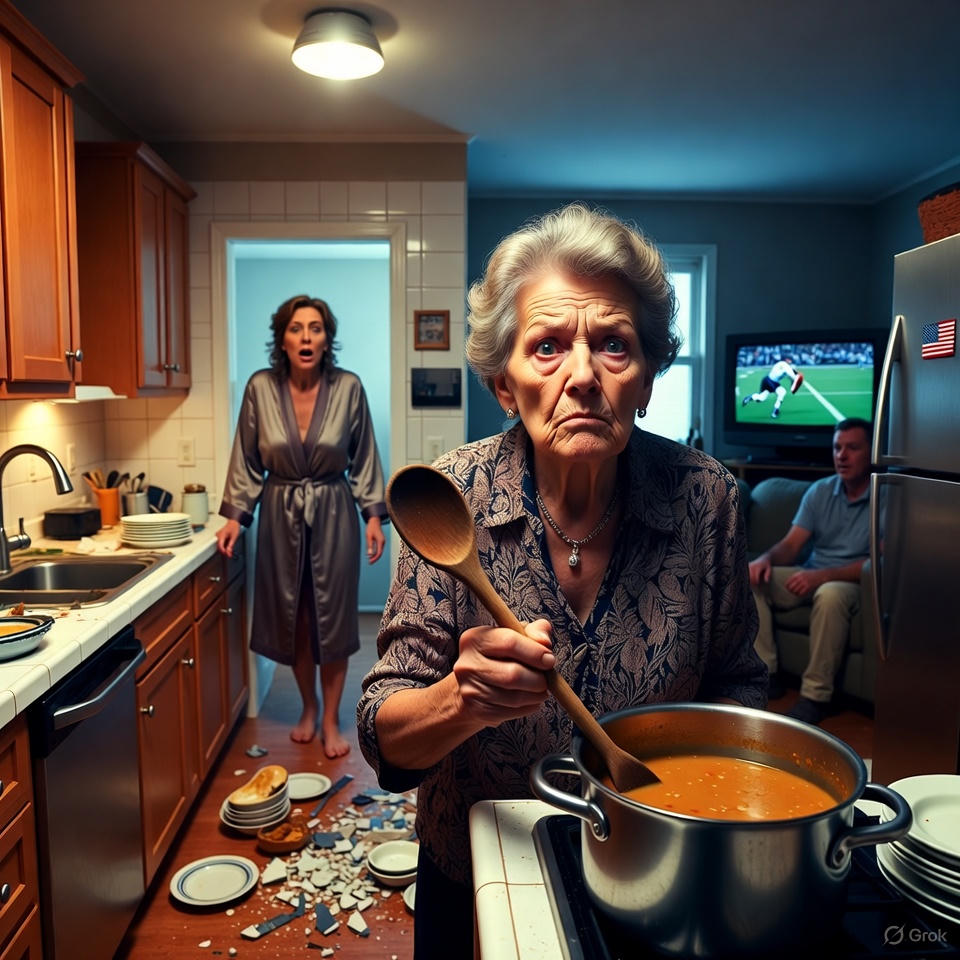
I was making soup when my daughter-in-law struck my head with a ladle.
“Who cooks like that, you incompetent?” shouted Dawn as I felt the hot metal searing against my temple.
My son, Robert, sitting in the living room, simply turned up the volume on the television, as if he hadn’t heard, as if it didn’t matter.
Five minutes later, a deafening crash came from the kitchen. Pots, dishes, my body hitting the floor. Robert ran over and froze in the doorway.
“Mom, what did you do?” he whispered, looking at me sprawled among the wreckage of my own dignity.
But what neither of them knew in that moment was that I still had one last card hidden. A card that would change everything.
My name is Helen. I am seventy-one years old, with hands calloused by decades of kneading bread for others and a heart that, until recently, believed blindly in family loyalty. What a fool I was. How blind I had been.
Six months ago, I buried my husband, Henry. Fifty years of marriage evaporated one April afternoon when his heart decided to give up while he was watering the geraniums in the backyard. I found him there on his knees, the hose still dripping water onto his brown shoes.
Since that day, my world became silence and yellowing photographs. I was left alone in a house that was too big, surrounded by memories that hurt to touch.
Robert, my only son, insisted that I move in with him and his wife.
“You can’t be alone, Mom. At your age, it’s dangerous,” he sounded worried over the phone.
I wanted to believe him. I needed to believe him. So I packed my life into four suitcases and left behind the house where I raised my son, where Henry and I used to dance in the kitchen on Sundays, where every corner held pieces of us.
Robert’s house was modern, with gleaming floors and furniture that looked straight out of a magazine. Dawn, my daughter-in-law, greeted me with a smile that didn’t reach her eyes.
“Welcome, Helen,” she said, without calling me mother-in-law, without calling me Mom. Just Helen, as if I were a stranger.
From the very first day, I knew I had made a mistake, but it was too late to go back.
I settled into the guest room, a small room at the end of the hall with a window that overlooked a dark alley. I hung Henry’s photographs on the wall, neatly arranged my gray dresses in the closet, and tried to make myself invisible. That was my new role: existing without being in the way.
Mornings began early. I got up at six, brewed coffee, made breakfast—scrambled eggs, toast, freshly squeezed orange juice. Robert came down first, always in a hurry, always looking at his phone.
“Thanks, Mom,” he would mumble without looking up.
Dawn appeared later, wrapped in a green silk robe, her hair perfectly styled even at that hour. She sat at the table and scrutinized every detail of my work with critical eyes.
“The coffee is watery,” she would say. “The eggs have too much salt.”
Never a thank you. Never an acknowledgement.
I just nodded, smiled, and tried again the next day.
I wanted to be useful. I wanted to be needed. I wanted to believe I still had a place in my son’s life.
Days turned into weeks. I cleaned, cooked, did the laundry. I became a shadow moving through the house, picking up crumbs, folding towels, tidying spaces no one else saw.
Dawn worked from home, always on important calls, always stressed. When something went wrong in her day, I was the easiest target.
“Why did you leave this here?” she would yell at me, pointing to a cup I had forgotten on the side table. “You can’t do anything right.”
Robert was present during these moments, but he never said a thing. He just looked the other way, as if it wasn’t his problem, as if I wasn’t his mother.
There were nights when I stayed awake, listening to the wall clock tick every second. I wondered what I had done wrong. Where had I failed as a mother? Why did my son allow me to be treated this way?
Tears fell silently onto my pillow, and I dried them before dawn because I couldn’t show weakness. I couldn’t give them a reason to get rid of me.
But that afternoon, while I was preparing the vegetable soup that Robert loved so much as a boy, something broke.
I was chopping carrots, focused on making everything perfect, when Dawn burst into the kitchen like a hurricane.
“What are you doing?” she asked with that sharp voice I knew too well.
“Soup for dinner,” I replied softly without turning around. “Robert’s favorite recipe.”
She moved closer, looked into the pot, and her face twisted in disgust.
“This looks like pig slop. How much salt did you put in? Are you trying to poison us?”
Her words were daggers. I tried to explain, but she wouldn’t listen. She grabbed the ladle from the pot and, before I could react, slammed it against my head.
The blow left me stunned. I felt the heat of the metal, the boiling liquid running down my hair, the sharp pain in my temple.
“Who cooks like that, you incompetent?” Dawn screamed, her voice echoing throughout the house.
I stumbled, holding on to the edge of the stove. From the living room, I heard the television. Robert was there. He could hear everything, and he just turned up the volume.
That was the moment something inside me went out. The physical pain was nothing compared to the betrayal of that silence. My son—the boy I carried in my womb, whom I raised with every ounce of love I had—chose the sound of a TV show over my suffering.
I stood there, leaning against the stove, the ladle still dripping soup at my feet. Dawn looked at me with those eyes full of contempt, waiting for me to apologize, to kneel, to beg her forgiveness for existing.
But I could only think of Robert, of how the television volume had increased just as she screamed, of how he knew exactly what was happening and chose not to see it.
“You’re pathetic,” Dawn spat, crossing her arms. “Look at this mess. You can’t even make a damn soup. I don’t know why Robert insisted on bringing you here. You’re a burden, a useless person just taking up space.”
Every word was a slap. I wanted to answer, to defend myself, but my voice was trapped somewhere deep in my throat.
I tried to clean up, to collect the drops of soup from the floor, but my hands were trembling. My head was throbbing where the ladle had hit.
Dawn stormed out of the kitchen and I was left alone amid the steam and the silence.
Five minutes. That was all it took for me to make a decision.
I looked at the pots lined up on the stove. I looked at the dishes piled in the drainer. I looked at that kitchen that I had cleaned every day for months, trying to earn a place in this house that was never mine.
And something inside me simply exploded.
It wasn’t planned. It wasn’t calculated. It was pure survival instinct.
I grabbed the largest pot, the one containing the soup she had criticized so much, and emptied it into the sink. The hot liquid ran down the drain with an almost violent sound.
Then I grabbed another pot and another. I let them fall, some onto the floor, others against the kitchen counter. The plates slipped from my hands. The cups shattered. Cutlery flew through the air.
It was a chaotic, liberating, necessary clamor.
I heard Robert’s hurried footsteps.
“What was that?” he shouted from the hallway.
When he reached the kitchen, he stopped dead. His face paled as he saw me there, surrounded by overturned pots, spilled soup, and broken dishes. There was a trickle of blood on my temple where the ladle had hit me.
“Mom, what did you do?” he whispered, but he didn’t come closer. He didn’t touch me. He just looked at me as if I were to blame for everything.
Dawn appeared behind him, and her expression of horror quickly turned to fury.
“She’s crazy. Your mother is completely insane,” she shrieked, pointing at me as if I were a dangerous animal. “Look at this mess. She destroyed my entire kitchen. Call someone. Robert, this woman needs to be locked up.”
Robert looked at me. I looked back at him, hoping he would say something, that he would defend me, that he would at least ask why I had done this.
But he just shook his head, disappointed, ashamed.
“Mom, why?” he muttered. “Why do you do these things?”
“Why?” I repeated, and my voice sounded hoarse, broken. “Your wife hit me with a boiling ladle. Robert, she hit me. And you turned up the television volume.”
The words came out like knives.
He blinked, confused, or perhaps feigning confusion.

Yo Make również polubił
Jak Przygotować Zimne Ciasto Mleczne, Niskokaloryczne i Pyszne
1 cukinia i 2 jajka! Tego przepisu nauczyła mnie babcia! Teraz robię go tylko w ten sposób!
Jajka faszerowane boczkiem: rozpływający się w ustach przepis na popularną przystawkę
Pieczone ziemniaki z cebulą: prosty i smaczny przepis na przystawkę