
The next morning, I packed my things and moved straight into my own beach house in Florida. Three weeks later, when I finally decided to walk away for good, everything began to turn around and the truth slowly came to light.
My father screamed at me to get out in front of the whole family, treating me like a parasite. I just nodded and walked away without a fight. By the time they woke up expecting an apology, I was standing on the balcony of my ninety‑million‑dollar Florida villa with my phone turned off.
They had no clue. They had just evicted the one person who secretly owned their debt.
My name is Melody Alvarez, and I had spent the last decade of my life making myself small so my family could feel big.
It was a Tuesday night in Cedar Ridge, Tennessee. One of those humid, cicada‑loud summer evenings in the American South that usually signaled a storm was brewing, though I didn’t realize the storm would be sitting at our dining room table.
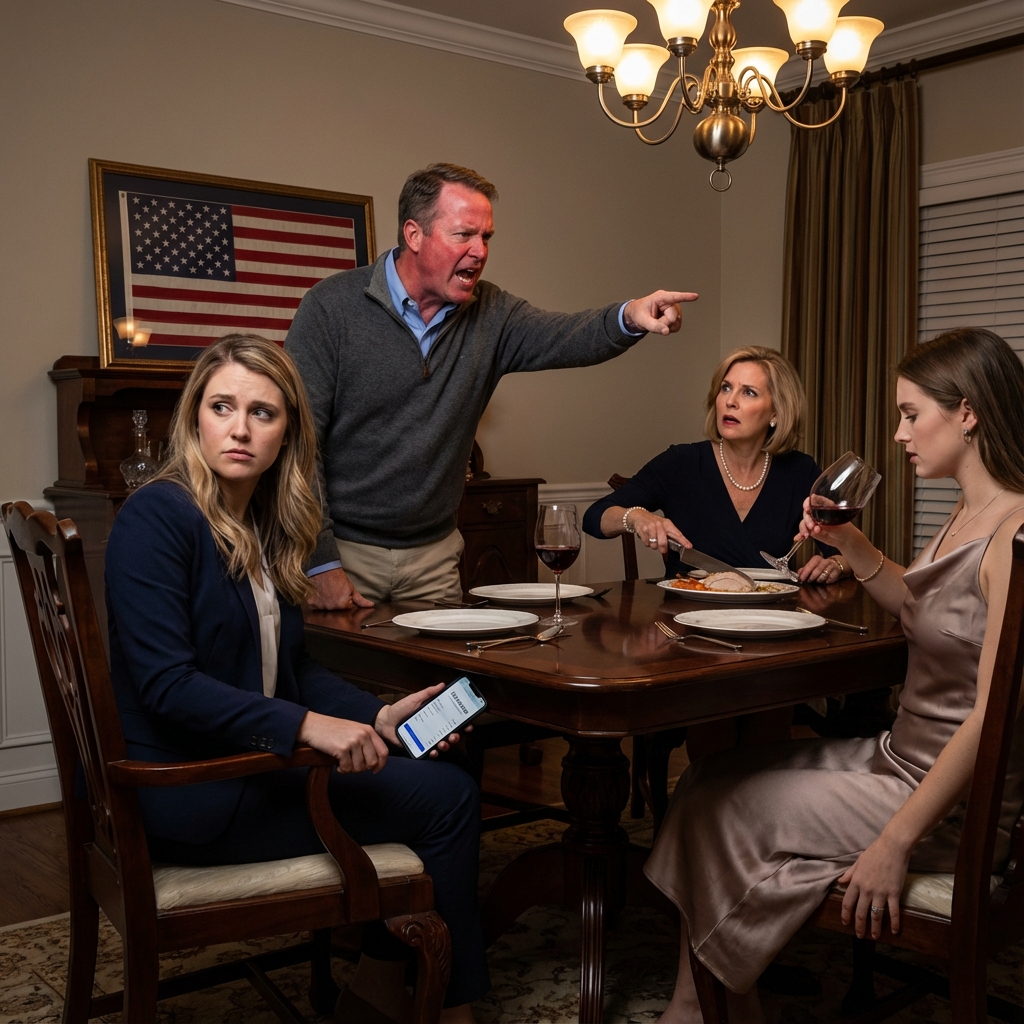
We were halfway through a dinner my mother, Cynthia, had insisted was crucial for “family unity.” In reality, it was a performance. My father, Dale Whitaker, was holding court at the head of the mahogany table, swirling a glass of Cabernet that cost more than my first car. Our guests were the Gables, a couple from the local country club with just enough money to be useful and just enough gullibility to believe Dale was the titan of industry he pretended to be.
I sat at the far end of the table near the kitchen door—my designated spot. It made it easier for me to get up and refill water glasses or clear plates, saving my mother the embarrassment of admitting we could not currently afford a housekeeper.
Dale was in the middle of his favorite monologue, the one about the sanctity of the self‑made man. He leaned back, his silver hair catching the light of the crystal chandelier I had paid to repair three months ago.
“It’s all about foundation,” Dale said, his voice booming with a practiced baritone. “You build a family like you build a business. Strong pillars, unwavering loyalty. That’s how the Whitakers have survived the economic downturns. We pull together.”
Mr. Gable nodded enthusiastically, cutting into his steak. “That’s admirable, Dale. Truly. You don’t see that kind of unity much these days.”
“Exactly,” my sister Sloan chimed in.
She was sitting to Dale’s right, where she always sat. Naturally. Sloan was twenty‑seven, seven years my junior, and she shimmered. That was the only word for it. Her dress was a silk slip that probably cost six hundred dollars, and her hair was blown out to perfection.
She worked in public relations out of Nashville, a career path that seemed to consist mostly of attending parties and charging the Ubers, outfits, and “client dinners” to my credit card.
Sloan turned her bright, predatory smile toward me.
“That’s why we worry about Melody sometimes,” she said. “She’s so focused on the nuts and bolts—very transactional.”
I kept my face neutral and took a small bite of potatoes.
“Someone has to balance the checkbook, Sloan.”
Sloan laughed, a tinkling sound meant to be charming but grating on my nerves like sandpaper.
“See? That’s exactly what I mean. Always talking about checkbooks and balances. It’s so dry. Melody is the tactical one, but she lacks the vision thing. She calculates love like it’s a tax return.”
The Gables chuckled politely. I saw Mrs. Gable look at me with a mixture of pity and dismissal. To them, I was just the drab older sister, the logistics manager at a freight company, the one who wore blazers from outlet stores and drove a high‑mileage sedan. I was the background noise to the Whitaker show.
Dale cleared his throat, signaling a shift in the evening’s program. A knot tightened in my stomach. I knew this tone. This was the setup.
“Speaking of pulling together,” Dale said, locking eyes with me.
He put on his most benevolent fatherly expression, but the greed in his eyes was sharp enough to cut glass.
“Melody, sweetheart, I was looking at the club dues and the renovation costs for the pool house. We’re in a bit of a temporary pinch with liquidity. Just a cash‑flow timing issue. You understand.”
He was doing it in front of the guests. Weaponizing their presence to shame me into compliance. It was a tactic he had used a dozen times before. Usually, I would nod, mutter a quiet “yes,” and transfer the money later, under the table, to avoid a scene.
“How much of a pinch?” I asked.
My voice was steady, surprising even me.
Dale waved his hand dismissively.
“Oh, nothing major. Just need to cover about twelve thousand by Thursday. I’ll pay you back once the returns from the development deal come in next month. Just handle it tonight, will you?”
Twelve thousand dollars. He asked for it like he was asking for the salt.
Silence descended on the table. Mrs. Gable looked down at her plate, sensing the sudden tension. Cynthia was aggressively cutting her steak, refusing to look at me. She knew. They all knew. There was no development deal. There were no returns coming next month. There was just a bottomless pit of lifestyle maintenance I had been shoveling my salary into since I was twenty‑two.
Something inside me snapped. It wasn’t loud, like a breaking bone. It was quiet, like a switch flipping in a dark room.
I placed my fork down on the china.
“No,” I said.
Dale blinked. He looked as if I had started speaking Latin.
“Excuse me?”
“I asked a question,” I said, my voice rising just enough to be heard clearly over the soft jazz playing in the background. “Where’s the paperwork? If it’s a liquidity issue for the club dues and the pool house, show me the invoices. Show me the overdue notices.”
Dale’s face turned a mottled shade of red. The charm was evaporating, revealing the volatile narcissist underneath.
“We’re at dinner, Melody. Don’t be—”
“I’m not being anything,” I said, leaning forward. “I’m being practical. You said I’m transactional, right? So let’s treat this like a transaction. You want twelve thousand dollars. I want to see the paper trail. Because the last time I gave you money for club dues, I saw Sloan posting photos from a resort in Cabo three days later.”
Sloan gasped, her hand flying to her chest.
“That’s a lie. You’re just jealous because you never go anywhere.”
“Enough.”
Dale slammed his hand down on the table. The wine glasses jumped. The Gables flinched, looking terrified.
Dale stood up, looming over the table. The mask was completely gone now. He was no longer the silver‑haired patriarch. He was a bully who had been told no for the first time in years.
“How dare you?” he hissed, spit flying from his lips. “You ungrateful, miserable little leech. After everything we’ve done for you. We put a roof over your head. We let you live here in this house, eating our food. And you have the audacity to demand paperwork like you’re the IRS.”
“I pay the mortgage, Dad,” I said calmly. “And the utilities. And the insurance on Sloan’s car.”
“You pay rent!” Dale screamed. “You pay a pittance for the privilege of being a Whitaker. You think your little logistics job makes you important? You are nothing without this family. You’re a cold, heartless embarrassment.”
I looked at my mother. Cynthia was staring at the centerpiece, her face completely blank. She wouldn’t defend me. She never did. Protecting her lifestyle meant protecting Dale’s ego. If I had to be the sacrifice, so be it.
Then I looked at Sloan. She wasn’t looking down. She was looking at me, the corner of her mouth quirked up in a small, triumphant smirk.
That was the moment I realized this was not just a tantrum. This was a coordinated strike. They had talked about this. They knew they needed money. And they knew the only way to get it was to corner me publicly. They just hadn’t expected me to fight back.
Dale pointed a shaking finger at the front door.
“Get out!” he roared. “If you can’t support this family, then you don’t belong in this family. Get out of my house. Don’t come back until you’re ready to apologize on your knees and write that check.”
The echo of his scream hung in the air. The Gables were practically shrinking into their chairs, desperate to disappear.
In the past, the old Melody would have cried. She would have apologized, scrambled to transfer the funds just to stop the yelling, just to keep the peace.
But the old Melody died the moment she saw Sloan’s smirk.
I stood up slowly. I didn’t shake. I didn’t cry. I picked up my napkin, folded it neatly, and placed it on the table.
“Okay,” I said.
The word hung there, heavy and final.
Dale’s eyes widened slightly. He had expected begging. He had expected drama. He didn’t know what to do with “okay.”
“What?” he stammered.
“I said, ‘okay.’”
I turned and walked to the coat rack near the foyer. I grabbed my trench coat and my purse.
“Where do you think you’re going?” Cynthia called out, her voice shrill, finally breaking her silence. “Melody, don’t be dramatic. Sit down and finish dinner.”
“Dad told me to get out,” I said, opening the heavy oak front door. The night air rushed in, smelling of rain and ozone. “So I’m going. Good luck with the twelve thousand.”
I stepped out and closed the door behind me. I didn’t slam it. I closed it with a soft, decisive click.
I walked down the long paved driveway to where my car was parked. It was a five‑year‑old sedan, sensible and reliable. I got in, locked the doors, and sat there for a moment in the silence.
My heart beat a steady rhythm against my ribs. I waited for the panic to set in—the crushing fear of abandonment that had kept me tethered to them for so long.
But it didn’t come.
Instead, I felt a strange, light sensation in my chest.
Relief.
I pulled my phone out of my purse. The screen glowed in the darkness of the car. I didn’t open my contacts to call a friend. I didn’t open social media to vent. I opened my banking app.
For years, my family believed I was a mid‑level manager at Northvale Freight Solutions, making a decent but modest salary. They thought I was just good at saving pennies. They thought I was boring.
They didn’t know about Root Warden.
Four years earlier, I had written a piece of software to optimize freight logistics in difficult terrains. It was a side project, something I did on weekends to keep my brain sharp. I’d patented it, formed an anonymous LLC, and licensed it to three of the largest shipping conglomerates in the world. Six months ago, I sold the exclusive rights to a tech giant in Silicon Valley.
I used Face ID to log in. The loading circle spun for a second before the balance appeared on the screen.
It wasn’t twelve thousand.
The number staring back at me was ninety‑two million four hundred thousand dollars and change.
I stared at the number. It was a figure that could buy half of Cedar Ridge. It could buy the country club the Gables were so proud of. I had never touched it. I’d lived on my Northvale salary, putting every spare cent into the Whitaker black hole, waiting for the day they would finally appreciate me—waiting for them to love me for me, not for what I could provide.
That wait was over.
I put the car in reverse. As I backed out of the driveway, my phone buzzed with a text message. I glanced at the screen. It was from Sloan.
I hope you know you’re ruining everything. Dad is furious. By the way, don’t bother coming back for your stuff tomorrow. We need your room. The lighting is better in there for my studio. I’m putting your boxes in the garage.
I stared at the message. She was already measuring the drapes. She thought she had won. She thought she had exiled me to the wilderness, stripping me of the only home I had.
I typed no reply. I deleted the thread, then blocked her number. Then I blocked Dad. Then Mom.
I looked in the rearview mirror. The house glowed in the distance, a beacon of pretension and rot. They were probably still at the table, drinking the wine I paid for, convinced that by tomorrow morning I’d be back, groveling, checkbook in hand.
They had no idea.
They thought they had just kicked out a daughter who was a financial burden. They didn’t realize they had just severed ties with the person who held the note on their mortgage.
I shifted the car into drive and pressed the gas. I wasn’t going to a hotel. I was going to the airport.
The private jet I had chartered under my company’s name was waiting on the tarmac, ready to take me to Naples, Florida.
Their “get out” wasn’t an eviction. It was a liberation.
As the Gulfstream climbed through thirty thousand feet, putting miles of black sky between me and the toxicity of Cedar Ridge, the silence of the cabin should have been peaceful.
Instead, it was loud with memory.
The hum of the engines sounded like the ghost of my own internal monologue, the one that had been running on a loop for twelve years.
I closed my eyes and leaned back against the leather headrest, and suddenly I was twenty‑two years old again.
That was the year the invisible contract was signed.
I had just landed my first junior analyst position at Northvale Freight Solutions. I was making thirty‑eight thousand dollars a year, a sum that felt enormous to a fresh graduate, but was barely a rounding error in my father’s world.
I remembered coming home one evening, proud of my first paycheck, only to find the house submerged in a thick, panicked tension. There was a red notice on the kitchen counter. The electricity was scheduled to be cut off the next morning.
Dale was pacing the living room, ranting about bank errors and incompetence, about how a wire transfer from a client in London was stuck “in clearing.” It was a lie. Even then, deep down, I knew it was a lie. But the shame radiating off him was real. The fear that the neighbors on our quiet Tennessee cul‑de‑sac would see a utility truck pulling the meter was palpable.
“I can handle it,” I’d said.
I remembered the exact feeling in my chest when I said those words. A mix of pride and desperation. I wanted to be the hero. I wanted to prove I was an adult, a contributor, a real Whitaker.
I paid the three hundred forty dollars.
Dale didn’t say thank you. He just clapped me on the shoulder and said, “Good girl. Team effort. I’ll square up with you on Friday.”

Yo Make również polubił
Dlaczego Warto Posypywać Parapety Grubą Solą? Niezwykły Powód, Którego Nie Znaliście!
Dlaczego nigdy nie należy stawiać wolnowaru na kuchence
Czy Wiesz, Jakie Skutki Może Mieć Czarny Plastik?
UWAGA, jeśli masz na ciele takie siniaki, oznacza to, że masz Ca…