
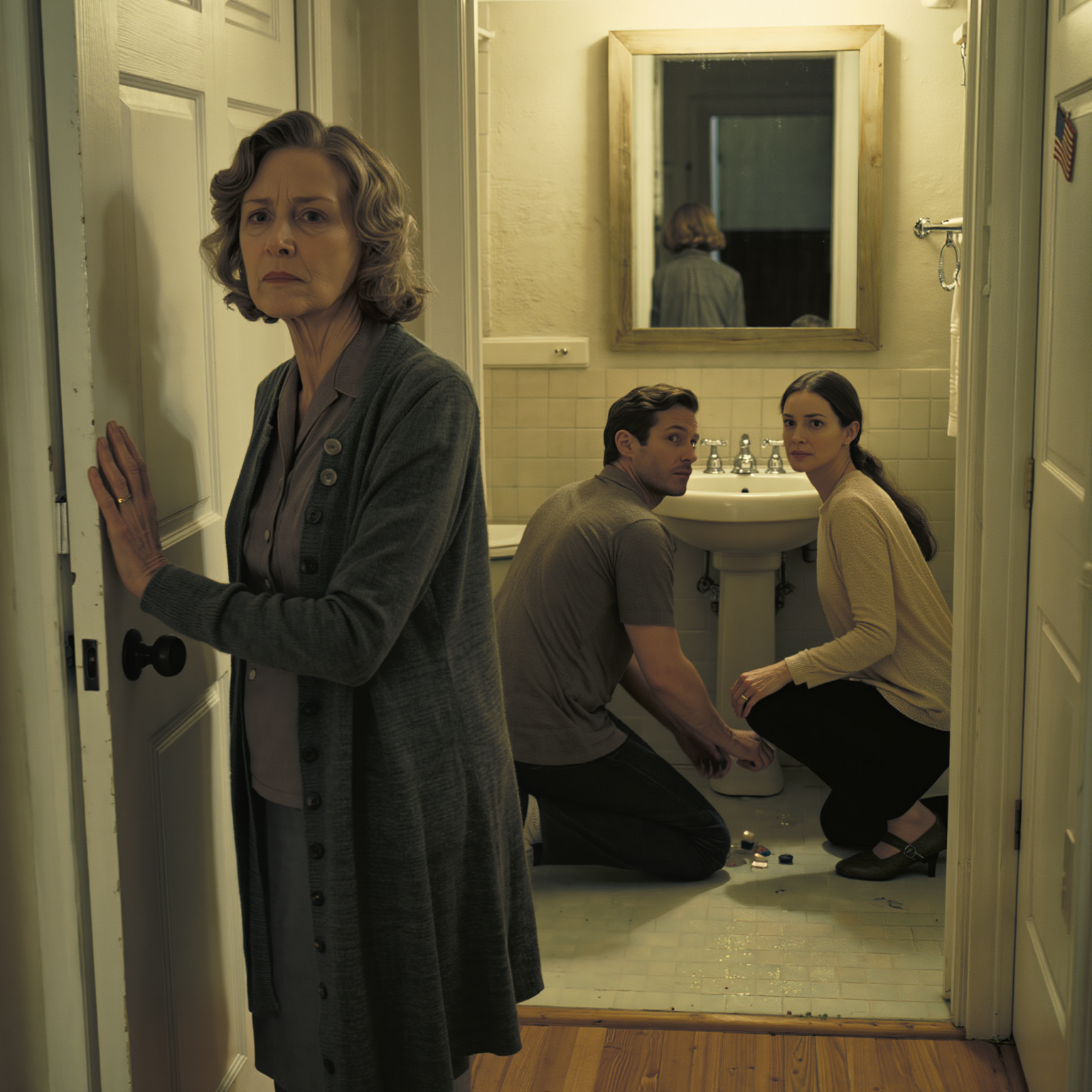
“Soon,” she said. “I’m thinking three weeks. That gives us time to finalize everything, track her schedule. We’ll pick a day when she’s definitely going to be out of the house for at least two hours so we can set everything up.”
“And you’re sure about the injury pattern?” he asked. “It’ll look accidental?”
Chenise actually sounded offended.
“Marcus, I’ve researched this extensively,” she said. “Do you know how many elderly people die from bathroom falls every year in the U.S.? Wet bathroom floor, medications that cause dizziness, head trauma on a hard surface—it’s textbook. No medical examiner is going to question it.”
I’d spent decades on the other side of that equation, standing over tables in cold autopsy rooms in Atlanta, ruling deaths accidental when they were genuine accidents, and flagging the ones that weren’t.
I knew exactly what she was talking about.
My heart was pounding so hard I was sure they’d hear it through the door, but the years had taught me how to lock my body down when I needed to. I backed away from the bathroom in tiny, controlled movements, never letting the floorboards creak.
When I reached the top of the stairs, I turned and went down, holding the rail so my hands wouldn’t shake.
I slipped out the front door, closing it quietly behind me, and walked to my car like a woman in a dream. I sat behind the wheel and let the reality land: my son and his wife had just rehearsed my murder.
I started shaking so hard my keys rattled.
I forced myself to breathe. In. Out. In. Out.
Five minutes later, I put the car in drive, circled the block, and parked at the small neighborhood park two streets over—the one with the squeaky swings and the faded “Welcome to Brookside Estates” sign.
I sat there staring at the playground and the neat row of mailboxes, thinking about the conversations I’d had with grieving families over the years, trying to explain why a death was suspicious, why we were ruling it homicide.
Now I was the potential victim.
After fifteen minutes, I drove back home.
This time I pulled into the driveway like I always did. I closed the car door loudly, let my keys jingle, and didn’t bother trying to be quiet.
When I walked inside, Marcus and Chenise were on the living room sofa, watching some sitcom rerun. The television washed the room in blue light. They both looked up like they’d just dropped by to say hello.
“Mom.” Marcus stood up, smiling. “Hey, I didn’t know you’d be home so early.”
“The committee finished ahead of schedule,” I said, forcing my voice to stay light, turning on the warm Southern church-lady tone I’d perfected over the years. “What are you two doing here?”
“Just stopped by to check on you,” Chenise said sweetly. “We worry about you being in this big house all alone.”
It was the kind of line that would’ve sounded caring to anyone else. To me, it sounded like a death sentence wrapped in sugar.
I smiled and nodded.
“You’re sweet,” I said. “Let me just run up and grab my glasses. I’ll be right back.”
I walked up the stairs, my pulse hammering in my throat.
The bathroom was spotless.
The floor was completely dry. The rug was back in its usual straight, centered place. My pill bottles were lined up neatly in the cabinet, labels facing forward just like I kept them.
No water. No scattered pills. No marks on the tub.
They’d cleaned up every trace.
But I’d seen it. I knew what had been there.
I took my reading glasses from the nightstand, stood in the doorway of the bathroom for one long, steady breath, then went back downstairs.
“Found them,” I said, holding up the glasses. “Thank you for checking on me, you two. You’re very thoughtful.”
We sat and made small talk for ten more minutes. Traffic on I-85. A new brunch spot in Midtown. The Falcons. Nothing that mattered.
Then they left.
The second their car pulled away from the curb, I locked the front door. Then I walked to the back, locked the patio door, checked the windows, and set the alarm.
Only then did I go to my home office, close the door, and sit down at my desk.
I stared at the framed certificates on the wall—my diplomas, my board certifications, a citation from the State of Georgia thanking me for my years of service as a medical examiner. I looked at the shelves of forensic textbooks, some of which had my name on the cover.
And I said out loud, to the empty room, “My son is planning to kill me.”
Once I said it, there was no taking it back.
Most people in my position would have called 911 immediately. And if you ever find yourself in danger, you absolutely should call the police.
But I am not most people.
My name is Dr. Evelyn Morrison. I’m sixty-seven years old. I’m a retired forensic pathologist. I worked with the Georgia Bureau of Investigation’s Medical Examiner’s Office for thirty-five years in Atlanta. I’ve performed over two thousand autopsies. I’ve investigated hundreds of suspicious deaths. I’ve testified in sixty-three murder trials.
And I literally wrote the textbook on staged death scenes. It’s called Staged Death: Recognition Patterns in Homicide Investigations. It’s used in medical examiners’ offices and forensic training programs across the United States.
I know what a staged accident looks like. I can see it from a mile away.
And now my own son was trying to give me one.
I sat there and did what I’m trained to do: I analyzed.
Option one: call the police right now, report what I’d seen.
Problem: I had no physical evidence—not a photo, not a recording. By the time they got there, the bathroom was spotless. Marcus and Chenise would deny everything. It would be my word against theirs. They’d say I misunderstood. That I was confused. That I was grieving and imagining things. At my age, that kind of accusation sticks.
Option two: confront them directly.
Problem: they’d deny it. They’d cry. They’d gaslight. They might accelerate their plan or change it. I’d lose control of the situation and possibly my life.
Option three: do what I’d spent my entire career doing.
Gather evidence. Document everything. Build an airtight case. Catch them in the act.
I chose option three.
At two in the morning, after hours of staring at my computer screen without seeing the words, I picked up my phone and called my brother, Raymond.
Raymond is seventy-two, five years older than me. He lives now in a quiet town closer to Savannah, but for thirty years he worked for the FBI, in the forensic science division. He’s the person police departments call when they need the expert’s expert.
He answered on the third ring, his voice thick with sleep.
“Evelyn? What’s wrong?”
“Raymond,” I said, “I need your help.”
Instantly, his tone changed.
“Tell me.”
“Marcus and Chenise are planning to murder me,” I said. “They’re going to stage it as an accidental fall in my bathroom. I walked in on them rehearsing the scene tonight.”
Silence.
Then his voice came back, sharp and clear.
“Start from the beginning,” he said. “Tell me everything.”
I did. I told him about the wet floor, the scattered pills, the marked tub edge, their timeline, the plan to disable the cameras.
When I finished, my hand was cramped around the phone.
“Did they see you?” he asked.
“No,” I said. “I left quietly, drove around the block, came back and pretended everything was normal. They have no idea I know.”
“What do you want to do?”
“I want to let them continue,” I said. “But I want to document everything. I want them caught in the act. I want attempted murder and conspiracy charges that no defense attorney can chew through.”
“Evelyn, that’s incredibly dangerous,” he said. “We’re not talking about some abstract case. We’re talking about you.”
“I spent thirty-five years investigating murders, Raymond,” I said quietly. “I know how this works. I know how to protect myself. But if I go to the police with nothing except my word, they’ll maybe talk to Marcus, maybe scare them, maybe not. And if they walk away, they’ll just try again later, smarter.”
He was quiet for a moment.
“What do you need?”
“I need surveillance equipment,” I said. “Hidden cameras, audio. I need someone who can install it without leaving a trace. And I need coordination with local law enforcement so that when they make their move, officers are ready to come through my door in seconds, not minutes.”
He exhaled slowly.
“Give me twenty-four hours,” he said. “I’ll make some calls.”
“Raymond,” I added, “I’m not being dramatic when I say this: I’m going to need you to help me send my own son to prison.”
“I know,” he said softly. “And I hate that. But I hate the alternative more. We’re going to do this right. Just promise me you’ll be careful. These are murder stakes.”
“I know,” I said. “I promise.”
Two days later, he called back.
“All right,” he said. “Help is on the way. Do you remember Cameron Brooks?”
I did. Cameron had been a younger agent when Raymond was still at the Bureau—a sharp, quiet man with a knack for technology and patience for long nights in surveillance vans. He now ran a private investigation firm out of Atlanta, specializing in digital forensics and security.
“He’s flying in tomorrow,” Raymond said. “He’ll outfit your house with a full hidden surveillance system. Cameras, audio, the works. He’s also going to run surveillance on Marcus and Chenise—within the law. And I’ve reached out to a detective in Atlanta PD I trust completely. Her name’s Kesha Williams. Major Crimes. We’ll bring her in once the system is up.”
“Thank you,” I said. “I don’t know what I’d do without you.”
“You’d still find a way,” he said. “You always do.”
The next day, I met Cameron at a coffee shop in Decatur, a little place where the baristas know half the regulars by name and nobody looks twice at two people having an intense conversation.
“Dr. Morrison,” he said, shaking my hand. He was in his fifties now, a little gray at the temples, but that same FBI steadiness. “Raymond filled me in. I’m very sorry you’re going through this.”
“Thank you,” I said. “And thank you for coming.”
“What I need from you,” he said, “is a free house. Tomorrow, eight a.m. to around five p.m. I’ll bring my team, wire your place top to bottom—hidden cameras in every major room, audio throughout. Everything will feed to encrypted cloud storage. Only you, Raymond, and I will have access.”
“What about my existing security cameras?” I asked. “The ones my son knows about?”
“Leave them alone,” he said. “When your daughter-in-law thinks she’s disabled the system, she’ll feel safe. Meanwhile, the real system keeps running. They’ll never know.”
I nodded.
“I’ll also install a GPS tracker on your car,” he added, “and I’m going to give you a medical bracelet that’s actually a panic button. Press it, and it will send an alert with your exact location to 911, to me, and to Raymond.”
“Very clever,” I said. “You’ve been busy since I saw you last.”
He gave a small smile.
“I’ve seen a lot of terrible things,” he said quietly. “But family doing this… it hits different.”
The next morning, I left my house at 7:45 a.m., as if I had errands. I texted Marcus that I’d be spending the day with my sister Dorothy, who was “flying in” from California. She wasn’t actually there yet, but he didn’t need that detail.
Cameron pulled into my driveway at 7:59 a.m. with two technicians and several heavy cases that looked like toolboxes.
By five in the afternoon, my home was a fortress of invisible eyes and ears.
He walked me through it all afterward. Tiny pinhole cameras hidden in smoke detectors. One disguised as a decorative wall hook. Another embedded in a clock in the kitchen. A camera behind the air vent in the hallway. Microphones in light fixtures and in a plant pot on the console table.
“They’d have to gut your house to find these,” he said. “And by then, footage will already be backed up in three separate secure locations.”
He handed me the bracelet. It looked like any other medical alert bracelet you’d see on an older woman in Publix—the kind that says “DIABETIC” or “HEART PATIENT” in raised letters.
“This,” he said, “is your panic button. Press and hold for three seconds, and law enforcement gets your location. So do we. Don’t be a hero. If something goes wrong, press it.”
“I will,” I said.
He hesitated.

Yo Make również polubił
Kurczak rozpływający się w ustach: najlepszy przepis na łatwą kolację
Pływający kwiat DIY z makaronów basenowych
Na szóste urodziny mojej córki moi teściowie wysłali jej uroczego, brązowego misia. Na początku była podekscytowana, a potem nagle zamarła. „Mamo… co to jest?”. Przykucnęłam, żeby przyjrzeć się bliżej – i zbladłam. Nie krzyczałam. Nie protestowałam. Po cichu sobie z tym poradziłam. Trzy dni później policja stała przed ich drzwiami…
Prawda o tym, jak schudnąć 12 funtów w 3 dni — i dlaczego może to być szkodliwe.